

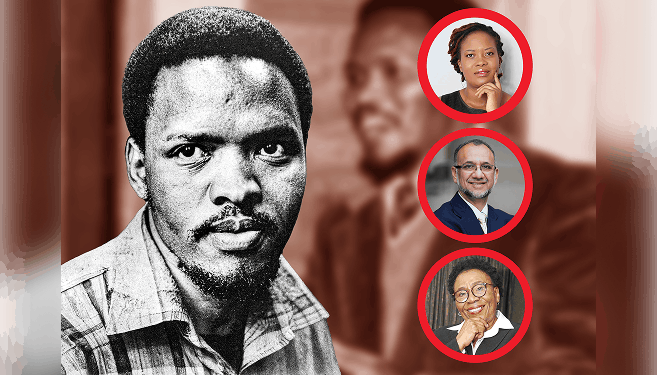
South Africans were challenged to reflect on the unfinished struggle for social justice, equality and genuine liberation during the annual Steve Biko Lecture hosted by the University of KwaZulu-Natal (UKZN) in partnership with Umtapo.
Held under the theme ‘Free the Mind – Biko, Black Solidarity, and South Africa’s Unfinished Revolution’, the webinar examined the continued relevance of Black Consciousness leader Steve Biko’s philosophy in addressing contemporary challenges, including corruption, inequality, ethnic nationalism, xenophobia and gender-based violence (GBV).
The lecture featured Professor Ziyad Motala, Professor of Law at Howard University School of Law in Washington, DC, as keynote speaker, with Professor Ntombifikile Mazibuko, Professor Emeritus at UKZN, responding. Development economist, socialist and activist Ms Ntsako Mkhabela facilitated the discussion.
Welcoming participants, Executive Director of Corporate Relations, Dr Normah Zondo, emphasised the importance of remembering Biko’s legacy through meaningful dialogue that interrogates present-day realities.
“Each generation must confront it in its own time,” she said, referring to Biko’s vision of a quest for true humanity.
Zondo highlighted the significance of the lecture as an opportunity to bring together thinkers and public intellectuals to tackle difficult questions about the society South Africa is building. She also welcomed Motala, a University of Natal alumnus, whose academic career has focused on democracy, human rights and justice.
In his keynote address, Motala argued that commemorating Biko should extend beyond remembering his words about confronting the inequalities and power structures he challenged.
“Black solidarity was the method; humanity was the destination,” he said, emphasising that Black Consciousness was not about reversing racial domination but creating a society in which everyone’s dignity is respected.
Motala reflected on Biko’s belief that liberation begins with freeing the mind from systems that shape how people understand themselves and others. He warned that political freedom alone did not guarantee social and economic transformation, particularly when corruption and elite interests undermine the aspirations of ordinary citizens.
Drawing on South Africa’s experience of state capture, he argued that corruption had consequences far beyond financial losses, depriving communities of essential services, educational opportunities, healthcare and economic advancement.
He also highlighted the dangers of identity-based politics, warning that racial and ethnic divisions can distract from shared socioeconomic challenges. While acknowledging the importance of cultural identity and historical recognition, he urged South Africans to reject forms of belonging that depend on excluding or diminishing others.
“Your child’s future and mine are connected,” he said, calling for solidarity that transcends racial, ethnic and national boundaries.
Motala further challenged South Africans to confront GBV and xenophobia, stressing that a society cannot claim to be liberated while women live in fear or migrants are blamed for structural problems such as unemployment and poverty.
He extended the discussion to international solidarity and Palestine, arguing that human rights and human dignity must be defended consistently, regardless of the identity of those affected. He called for an independent South African foreign policy grounded in principle rather than dependence on powerful global interests.
Responding to the keynote address, Mazibuko affirmed the continuing relevance of Black Consciousness, drawing on her experiences as a student during the 1990s and her engagement with the philosophy in Higher Education.
She highlighted the importance of self-reliance, community participation and the development of alternative institutions that respond to the needs of marginalised communities. She also noted that the challenges confronting South Africa, including unemployment, poverty, GBV and economic exclusion, require sustained public engagement and practical solutions.
Mazibuko encouraged citizens to move beyond lamenting the country’s problems and take responsibility for shaping its future through critical thinking, collective action and continued dialogue.
The date of the lecture carried particular historical significance. On 19 October, 1977, a month after Biko died in police custody, the apartheid government banned 17 Black Consciousness organisations, alongside The World newspaper and its editor, Mr Percy Qoboza. The crackdown became known as Black Wednesday and represented an attempt to silence the movement associated with Biko’s ideas.
The lecture therefore served as both a commemoration and a call to action, challenging participants to consider how Biko’s principles could inform responses to contemporary social and political challenges.
Motala concluded that Biko’s legacy remained relevant precisely because South Africa’s pursuit of a just and humane society is unfinished. He urged citizens to resist racism, corruption, ethnic nationalism and every attempt to undermine the dignity of others.
The discussion reaffirmed the importance of keeping Biko’s ideas alive not merely through annual commemorations, but through sustained efforts to build a society founded on solidarity, equality and shared humanity.
Words: Nombuso Dlamini
Photographs: Supplied