

Media plays a powerful role in shaping public opinion, influencing political narratives and determining whose voices are heard.
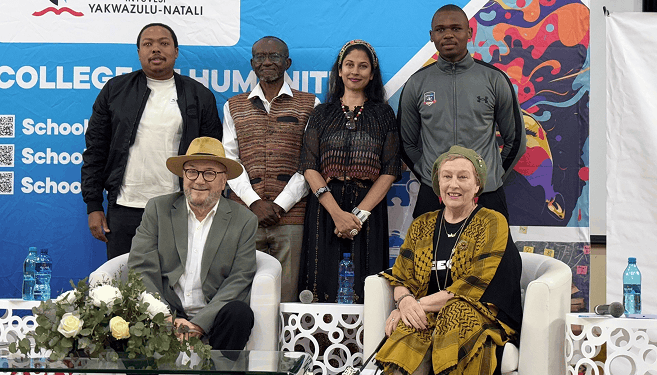
These issues came under scrutiny at a masterclass, featuring British broadcaster George Galloway and award-winning journalist Yvonne Ridley. Hosted by the College of Humanities under the theme ‘Media, Power & Justice’, the masterclass explored media influence, censorship, freedom of expression, artificial intelligence (AI) and journalistic accountability. The event included a welcome by Professor Donal McCracken, poetry performance by Ms Ongezwa Mbele, an introduction to the guest speakers by alumna Ms Shabnam Palesa Mohamed and UKZN’s Development Studies Professor Oliver Mtapuri who served as respondent.
Galloway is a British political commentator, writer, broadcaster and former Member of Parliament, known for his commentary on international affairs, geopolitics and media power.
Ridley is a British journalist, author and anti-war campaigner whose work examines power structures, Western foreign policy and international affairs. Her political outlook is informed by Scottish working-class and anti-imperialist traditions, including figures such as Jimmy Reid, John MacLean and Mary Barbour.
Both speakers challenged participants to question established narratives and consider how political and economic interests can influence the information reaching the public.
Reflecting on his career in broadcasting and politics, Galloway examined how technological advances have transformed the production and distribution of information. Whereas traditional broadcasting once required substantial infrastructure, expensive equipment and significant financial investment, smartphones and social media now allow individuals to communicate directly with audiences around the world.
“With this technological device in your hand, you become the voice for the voiceless,” he said, highlighting the potential of smartphones to broaden participation in public debate.
However, he warned that the shift towards digital communication also creates new vulnerabilities. Although individuals can publish content independently, their ability to reach audiences may still depend on platforms controlled by powerful technology companies.
“Nobody under the age of 35 ever looks at a newspaper or listens to mainstream television. That’s why they’re now moving the guns on how they can control the platforms that we are all on,” Galloway said during his discussion of changing media consumption and platform control.
He also shared his experiences of what he described as digital and administrative suppression, including scrutiny by state institutions and the freezing of financial services. These experiences informed his concerns about the ability of powerful institutions to restrict participation in public discourse.
Turning to AI, Galloway cautioned that automated journalism could reproduce existing weaknesses and biases in mainstream reporting.
“Journalism produced by artificial intelligence will contain all of the deficiencies of mainstream media,” he said.
His presentation raised questions about who controls emerging communication technologies and whether digital innovation will expand media freedom or introduce new mechanisms of control.
Marking 50 years in journalism, Ridley focused on the principles of accuracy, accountability and evidence-based reporting. She distinguished journalism from other forms of communication, arguing that the purpose of reporting is to inform audiences rather than persuade them or secure their attention.
“An influencer wants to influence you, a propagandist wants to persuade you, a politician wants your support, an advertiser wants your money. A journalist wants something quite different again: to be properly informed!” she explained.
Ridley illustrated the importance of this distinction through her experience in Afghanistan in 2001, when she was captured by the Taliban while working as a journalist. She described the pressure she faced to recount an experience that aligned with the expectations of some media outlets.
“When I eventually came home from Afghanistan, there was a story that people wanted me to tell – their brutality, they’re monsters; they expected me to confirm everything they already believed. But the truth was that during my 11 days in captivity, I had been treated with respect and courtesy,” she recalled.
Ridley said her account challenged the expectations surrounding her experience and described the professional consequences of refusing to alter her testimony to fit a prevailing narrative.
“What was I supposed to do? Change the facts because the facts were unpopular? Tell my audience what they wanted to hear? The right-wing media would have loved me for it; instead, they cancelled me for it,” she added.
Her reflections highlighted the tension journalists can face between editorial expectations and their responsibility to report their experiences and findings accurately.
Ridley also considered the implications of misinformation for democratic participation, emphasising that disagreement over the interpretation of evidence is different from disagreement over whether facts can be established in the first place.
“Democracy can accommodate people disagreeing about what the facts mean, but it has a much bigger problem when we can no longer agree on what the facts are,” she observed.
For Ridley, critical thinking begins with a willingness to question information rather than accept it at face value. She urged participants to scrutinise sources, examine statistics and seek the context behind claims, particularly when information circulates rapidly through social media.
“I’m going to give you the most important question ever: ‘How do you know’? If somebody gives you an extraordinary statistic, ask where it came from,” she advised.
The question offered a practical principle for journalists and media consumers alike: information must be examined and verified before being accepted as fact.
At the conclusion of the programme, Director of Corporate Affairs, Ms Xoliswa Zulu, reflected on the key themes explored during the event, saying: “Today we have touched on the power of media and social media, free speech and censorship, journalism and democracy, as well as citizen journalism and activism. One thing that remains clear is that while the media landscape continues to change, the value of good journalism, critical thinking and responsible storytelling remains.”
Click here to watch: Media Masterclass: Galloway-Ridley SA Tour | Media, Power & Justice
Words: Sinoyolo Mahlasela
Photograph: Supplied