

Click here for isiZulu version
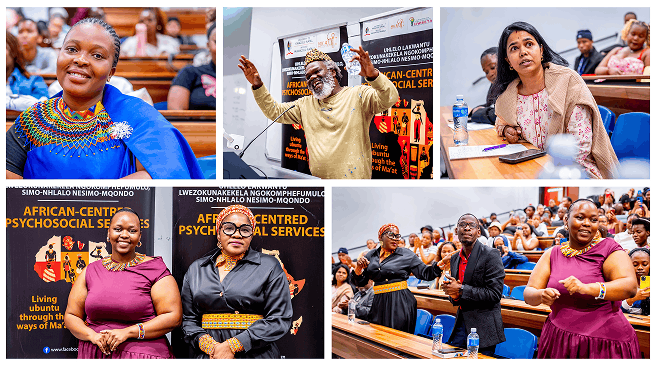
The relationship between cultural heritage, identity and wellbeing took centre stage at the University of KwaZulu-Natal (UKZN) during a public lecture titled: ‘Asiyeni Exhibeni: Reclaiming UQOBO, Reconnecting with Our Heritage and Restoring Our Wellbeing’.
Hosted by the Ma’at Institute and the Mbuso Khoza Institute, the lecture featured renowned musician, writer and cultural knowledge bearer Mbuso Khoza, who explored the importance of reconnecting with African heritage and Indigenous Knowledge Systems (IKS) as part of understanding the self and restoring wellbeing.
The lecture invited participants to reflect on UQOBO, presented as the inner self encompassing the spirit and intellect, and how this understanding connects to culture, language, history, family and community.
Welcoming participants, Dr Bongane Mzinyane, a lecturer in Social Work, described the University as “umbhoshongo ongathintwa” – a tower that should not be touched – drawing attention to the role of universities as spaces where community knowledge and academic learning could meet.
The discussion challenged narrow understandings of wellbeing that focus primarily on physical and psychological health. It also highlighted the interconnectedness of the body, mind, soul and spirit, as well as the influence of cultural identity, collective memory, relationships and historical experiences.
Said Mzinyane: “Reconnecting with one’s roots is not simply about looking back at the past; it is also about understanding how cultural knowledge continues to shape identity, belonging and wellbeing in contemporary society.”
This event demonstrated that heritage becomes more than a collection of customs and traditions. It provides a framework through which individuals can understand themselves, their communities and their place in the world.
Music, poetry, praise poetry and storytelling emerged as important ways of preserving and transmitting knowledge across generations. Reflecting on them as cultural practices that help children and young people develop an understanding of their ancestry, language and community, Ma’at Institute member Mr Kwanele Xaba stated that such practices demonstrated how heritage lives through everyday expressions, family relationships and community traditions. He emphasised the importance of passing on these traditions to the next generation, adding that “they also highlight the responsibility of families and communities to ensure that cultural knowledge continues to be shared with younger generations. Through music, language, storytelling and family traditions, knowledge is passed from one generation to the next.”
The event also encouraged dialogue between academic institutions and the communities whose knowledge and lived experiences enrich teaching, research and practice.
Closing reflections and a vote of thanks by Professor Sibonisile Zibane reinforced the importance of returning to one’s roots, with song adding a fitting conclusion to the gathering.
For self-reflection, a thought-provoking question was posed by Ms Zama Mbhele, a Ma’at Practitioner: if language shapes how we understand ourselves, what happens when the language through which we understand ourselves becomes disconnected from our heritage? This question invited a deeper reflection on the relationship between language, identity, cultural heritage, and our understanding of self.
Words: Sinoyolo Mahlasela
Photographs: Supplied