

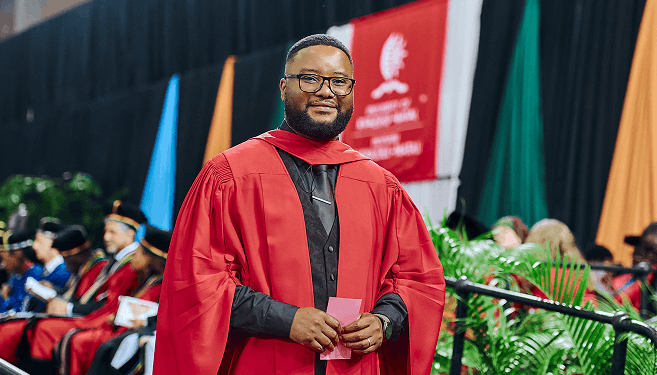
Dr Mpumelelo Gumede recently earned his PhD in Physics Education, contributing to science teacher education through research that examined how preservice teachers transform their physics knowledge into effective teaching practice.
Gumede’s research focused on motion graphs (kinematics), a topic that can appear simple but is often conceptually challenging for both learners and teachers.
His study explored how preservice teachers develop the knowledge and skills needed to teach Physical Sciences, with particular attention to enacted pedagogical content knowledge (PCK) – how teachers apply what they know when they are actually teaching.
One of the key findings was what Gumede describes as the ‘fragile knowledge’ problem: strong subject knowledge does not necessarily translate into strong teaching ability.
Gumede provided an example: “A student teacher can understand motion graphs perfectly and still struggle to explain them to learners or to spot where learners go wrong.”
Gumede highlights the importance of deliberately developing teaching skills alongside subject knowledge in teacher education programmes through targeted teaching interventions.
As a means to develop teacher skills, he designed an intervention grounded in social constructivism, combining guided collaborative worksheets, practical investigations, classroom discussions, problem-solving scenarios, curated videos, scenario-based graph synthesis and Physics Education Technology (PhET) simulations.
The intervention focused specifically on the sub-skills and misconceptions that preservice teachers struggled with. Following the intervention, their scores increased from approximately 39% to nearly 86%.
For Gumede, the improvement demonstrated the potential of carefully targeted approaches to teacher education.
“My research matters because good teaching is at the heart of a strong education system,” he said. “If we can prepare science teachers better, learners benefit, and that has knock-on effects for the country as a whole.”
His research could therefore assist universities and teacher-training programmes in developing more effective approaches to preparing Physical Sciences teachers. Rather than relying on broad, one-size-fits-all approaches, the findings suggest that identifying specific gaps in teachers’ knowledge and addressing them directly can improve learning outcomes.
Conducting the research while managing a full teaching and administrative workload presented challenges, including finding sufficient time for research and navigating the complexities of Rasch measurement, a statistical approach used to analyse test data. Converting his doctoral research into journal articles has also become an important part of his academic journey.
Gumede was supported through the New Generation of Academics Programme (nGAP), a Department of Higher Education and Training initiative aimed at developing early-career academics. He also received limited National Research Foundation funding for equipment during data collection.
His advice to fellow postgraduate researchers is to remain disciplined and consistent. “A PhD or master’s is a long journey, and steady, regular progress, even small amounts, adds up far more than occasional bursts of intense work.”
Words: Sinoyolo Mahlasela
Photograph: Sethu Dlamini