

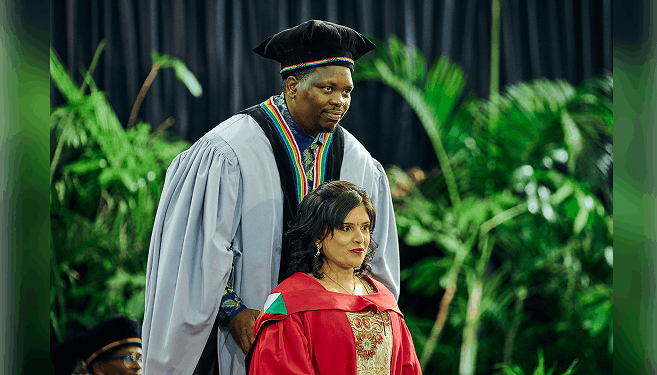
University of KwaZulu-Natal (UKZN) Educational Psychology PhD graduate Dr Serishma Gopie is using her research to contribute to more inclusive and responsive education for learners with autism spectrum disorder (ASD).
Gopie’s research explored Foundation Phase teachers’ perspectives on the use of educational technological resources when teaching and supporting learners with ASD in special needs schools in KwaZulu-Natal. Her study examined how teachers used educational technology, the benefits they perceive for learners, the challenges they experience and the support required to integrate technology effectively.
Her interest in the topic was shaped by her professional experience as a Foundation Phase educator and educational psychologist, as well as her passion for inclusive learning and supporting learners who experience barriers to learning.
A significant outcome of the research was the development of the (Inclusive Contextual Technological Integration) ‘ICTI-ASD model’, a context-sensitive framework designed to guide the integration of educational technology when teaching learners with ASD.
According to Gopie, the research demonstrated that technology has the potential to enhance learner engagement, motivation and participation while supporting diverse learning needs. However, she stressed that simply making technological devices available does not guarantee effective integration.
“Teachers require appropriate knowledge, confidence, training, technical support and access to suitable resources,” she said.
Gopie’s study identified several barriers to the effective use of educational technology, including limited technological resources, infrastructure challenges, time constraints and inadequate ongoing professional development. The ICTI-ASD model therefore responds to these challenges by bringing together technological, pedagogical, content, inclusive and contextual knowledge.
Gopie believes the findings can contribute to improved teacher support, more effective technology integration and better learning opportunities for learners with ASD.
Her doctoral journey also provided opportunities to share her research beyond South Africa.
“One of my highlights was presenting my work at the International Conference on Education (ICEDU) in Bali, where I engaged with an international academic audience and received feedback on my research.”
She also highlighted the publication of her research in Journal of South African Democratic Teachers Union (JSADTU) and Perspectives in Education (PIE), describing the progression of her work from an initial idea through data collection and analysis to published academic research as particularly rewarding.
Despite challenges in accessing research sites and securing participation from schools, she remained committed to completing her research and hopes that its impact will extend beyond her thesis.
Gopie plans to continue contributing to inclusive education, educational psychology, teacher development and educational technology through research and professional practice.
She also hopes to further investigate the ICTI-ASD model in different educational contexts and contribute to professional development initiatives supporting teachers who work with learners with diverse learning needs.
Her message to fellow postgraduate researchers is simple: “Remember why you started. Your research has the potential to make a difference, even when the journey feels difficult.”
Words: Sinoyolo Mahlasela
Photograph: Tisetso Nhlapo