

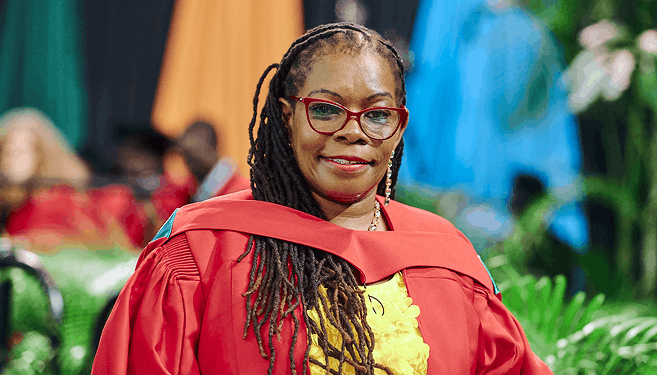
More than a decade after setting herself the goal of pursuing a PhD in 2012, Dr Thembi Dube has graduated from the University of KwaZulu-Natal (UKZN).
Her research gives greater prominence to learners’ perspectives on how digital technology shapes their education.
Dube’s doctoral study, ‘Secondary School Chemistry Learners’ Lived Experiences of Using the Eswatini e-Learning Passport’, investigated how learners experienced the digital tool in their chemistry education and what could be done to make their learning more meaningful. She conducted the research under the supervision of Professor Simon Khoza.
Her findings reveal three forms of learners’ lived experience – authoritative, interactive and distinctive – suggesting that the Eswatini e-Learning Passport is a potentially high-quality curriculum. However, challenges such as limited access to smartphones, data bundles and internet connectivity can prevent learners from fully benefiting from the technology.
For Dube, one of the most significant discoveries was that learners did not want technology simply to replace traditional teacher-led instruction. Instead, they wanted to be actively involved in their learning, with teachers taking on a stronger role as moderators and facilitators of their learning rather than absolute knowledge-providers.
“Children are eager to learn using digital technology, but their ability to do so meaningfully is affected by the digital divide and the support available to them,” she explained, further emphasising the importance of considering learners’ opinions about their own learning.
The research also reinforced for Dube that technology cannot replace the human connection at the heart of education. While digital tools can expand opportunities for learning, her findings indicated that teacher presence remains indispensable, particularly in helping learners engage actively rather than passively. Her own journey has strengthened that conviction.
Having worked as a Science teacher, school inspector and lecturer at the University of Eswatini, Dube has long been interested in giving young people opportunities to express their views. “I simply love children,” she said, recalling how she dreamed of becoming a teacher from an early age.
Her doctoral studies brought challenges, particularly the extensive literature review required to engage critically with existing scholarship. Dube persevered, crediting Khoza’s guidance, demanding academic approach, and international seminars for helping her develop resilience and greater openness to scholarly debate. She also acknowledged her family for their encouragement and support throughout her studies, describing them as her “pillar of strength”.
Having reached what she describes as the apex of her studies, Dube is already looking ahead. She hopes to publish findings from her research, train educators and contribute to the advancement of science education in an increasingly digital environment. “I remain motivated and committed to advancing my efforts,” she said.
She also expressed her sincere appreciation to UKZN for giving her the opportunity to undertake the journey – one that she refers to as a long-deferred ambition that has now opened the door to new scholarly possibilities.
Words: Rakshika Sibran
Photograph: Sethu Dlamini