

Race, religion and national identity are deeply intertwined in South Africa’s history, and their influence continues to shape the present in complex ways.
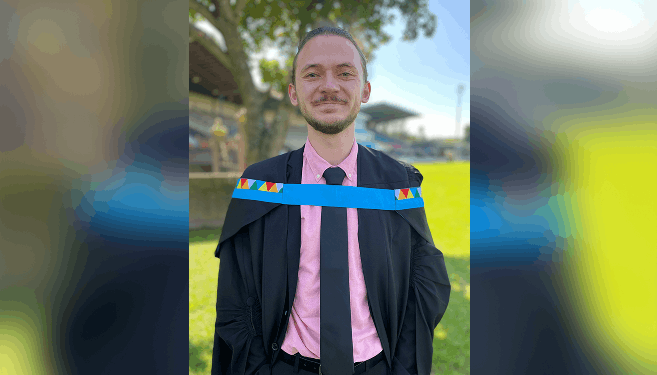
Dr David Elliott’s doctoral studies in Religion explores these intersections, examining how religious and vocational identities are formed within a society still negotiating the legacies of race and history.
His study, ‘Whiteness in/as Formation: Race, Religious and Vocational Identity Formation among Methodist Religious Leaders and their Communities in South Africa’, completed under the supervision of Professor Federico Settler, explored how religion, race, faith and national identity shape the ways people understand themselves and their communities. His interest in the subject developed alongside his own evolving understanding of race.
Using critical self-reflexivity, postcolonial historiography, a perception survey and semi-structured interviews, Elliott explored how historical entanglements of religion and race continue to inform contemporary identities and social relations. The novelty of his doctoral study received recognition in the form of a UKZN PhD scholarship as well as a fellowship from a South Africa-Germany research collaboration on Transformative Religion.
Initially intending to pursue full-time ministry, he became increasingly interested in critical religious scholarship and the ways in which religion, race and nation have shaped one another over time.
The research, especially the archival research conducted, prompted him to think more deeply about what is remembered and what is sometimes easier to forget when it comes to our racial histories.
“One thing that became apparent to me is that we have major gaps in our historical memory in certain spaces,” he said.
Conversations with research participants brought another dimension to the study. Elliott encountered people sincerely grappling with questions of identity, race and transformation, which reinforced his view that space is needed for thoughtful and constructive conversations about the past and present.
Having once believed that avoiding discussions about race could help overcome racial divisions, he came to recognise that not talking about race can also leave racialised privilege as well as trauma unexamined.
Elliott also drew on strong personal support throughout his doctoral studies. He credits his fiancée with helping him maintain perspective. They became engaged during his PhD, and he completed his research in the early hours of the morning while on holiday with her and her family.
“She has the most wonderful ability to remind me that there is a world outside of my work,” he said.
Recently appointed as an adjunct academic at Unisa, and poised to present some of his research at an international conference in Sweden this month, Elliott said, “I hope that people will take seriously how religion, race and nation interweave with each other.”
Elliott’s research seeks to encourage people to examine inherited ideas about identity, community and belief.
Words: Rakshika Sibran
Photograph: Supplied