

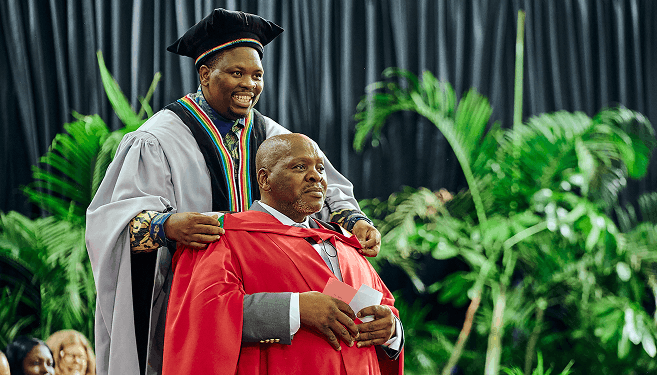
Dr Nqolobane Ntombela’s PhD study, ‘Learners Navigating School Violence: A Qualitative Study of Three Rural Secondary Schools in South Africa’, supervised by Dr Antoinette D’Amant, examined how learners experience and navigate violence in rural schools. The findings indicated that the problem extends beyond school grounds into the wider communities in which learners live.
Drawing on a career in education that includes two decades as a school principal, Ntombela was motivated to understand learners’ experiences from their own perspectives and to examine how schools can become safer, more supportive environments.
“I wanted to create a space where learners could tell their own stories and share their own knowledge and insights,” he said.
Through his qualitative study of three rural secondary schools, Ntombela found that school violence is more complex than isolated incidents between individual learners. Participants described experiences including bullying, intimidation, physical and verbal violence, sexual harassment, gender-based violence, substance use, theft and gang-related violence.
The research also highlighted the close relationship between school and community environments. Learners spoke of encountering violence on their way to school, witnessing violence in their communities and experiencing conflicts that sometimes carried over into the school environment.
For Ntombela, this demonstrated that schools cannot tackle violence in isolation.
“The school is part of the community,” he said, highlighting the need for collaboration between schools, families, communities and other stakeholders in developing sustainable responses.
Framed by restorative justice theory, the study highlights non-violent approaches to conflict resolution, with greater emphasis on dialogue, accountability, relationships and repairing harm rather than relying primarily on punishment.
Despite the difficult experiences shared by learners, Ntombela was encouraged by their resilience and their desire for safer and more peaceful schools. Their willingness to speak openly reinforced his belief in the importance of listening to young people when developing solutions to challenges that affect them.
“My message would be simple: listen to learners and take their experiences seriously,” he said.
Ntombela hopes his research will contribute to a stronger understanding of school violence in rural South Africa and encourage schools and communities to place learner voices at the centre of prevention and intervention strategies.
As he celebrated this academic milestone, Ntombela reflected on his commitment to education, social justice and creating safer environments in which learners can thrive. He expressed gratitude to D’Amant for her guidance, critical feedback and support throughout the research process. He also thanked his family, friends and colleagues for their encouragement, as well as the learners who participated in the study and the schools that made the research possible.
Words: Rakshika Sibran
Photograph: Sethu Dlamini