

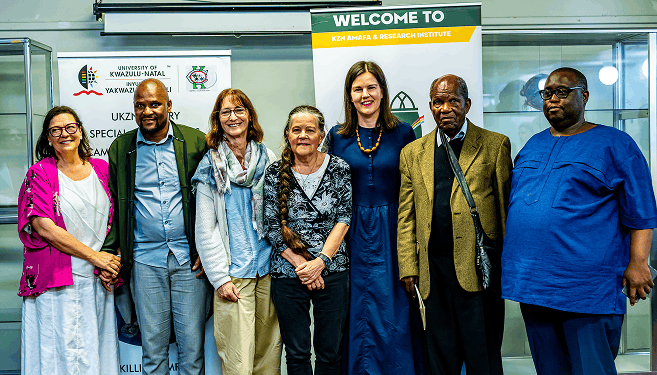
The launch of Sinikithemba: The Labour of Hope was held recently at the Masakhane Seminar Room at Killie Campbell Collections in Durban.
The occasion brought together academics, cultural heritage practitioners, colleagues, friends and members of the wider community to celebrate the publication of a book that invites reflection on history, knowledge, memory and the experiences that shape communities.
The setting at Killie Campbell Collections was particularly fitting for the occasion. As an institution dedicated to the preservation and interpretation of KwaZulu-Natal’s rich history and heritage, it provided a meaningful environment in which to introduce Sinikithemba to an audience deeply interested in scholarship, culture and the stories that connect generations. Of particular significance was the connection to the archives of McCord Hospital, which form an important part of the region’s medical and social history.
Those attending included the authors, Professor Catherine Burns, Dr Jennifer Upton and Dr Janet Giddy, alongside Professor Mags Beksinska, Emeritus Professor Paulus Zulu and Mr Mwelela Cele and colleagues from Amafa.
For the authors, the launch represented an important milestone in the journey of Sinikithemba. The publication of a book is more than the completion of a manuscript; it is an invitation for readers to engage with ideas, experiences, histories and stories that have been carefully brought together. The launch gave the authors an opportunity to introduce the book and acknowledge the people, institutions and communities that supported its publication.
Before and after the formal proceedings, guests exchanged ideas, reconnected with colleagues and discussed the role of books in preserving history and encouraging dialogue.
Mr Mwelela Cele read the biographies of authors Professor Catherine Burns, Dr Jennifer Upton and Dr Janet Giddy and formally introduced them.
Emeritus Professor Paulus Zulu, a former chairperson of the McCord Hospital board, responded to the publication. His contribution highlighted the importance of documenting the histories of KwaZulu-Natal’s communities and institutions.
Burns’ reflection, “Tea and scones can go a long way in a hospital,” highlights the importance of compassion, kindness and human connection in healthcare. It reminds us that care extends beyond medical treatment to include small gestures that offer comfort, dignity and a sense of belonging. McCord Hospital’s legacy, particularly during the HIV era, demonstrates how simple acts of humanity can provide hope and make a meaningful difference in patients’ lives.
Amafa’s participation highlighted the role of heritage institutions in preserving historical records and making them accessible to future generations.
The event also highlighted the value of collaboration between universities, heritage organisations, researchers, authors and communities in bringing historical research to wider audiences.
At its heart, the launch of Sinikithemba was therefore more than a formal book presentation. It was a celebration of knowledge and shared heritage, and an opportunity to recognise the collective work behind the publication. It brought together people with different experiences and areas of expertise, united by an appreciation for the importance of preserving stories and making them available to new generations.
For the authors, surrounded by colleagues, friends and members of the academic and heritage communities, the occasion marked both an ending and a beginning: the culmination of the publishing process and the beginning of the book’s life in the hands of its readers.
The launch of Sinikithemba: The Labour of Hope at Killie Campbell Collections will remain an important milestone in the book’s journey. More importantly, it served as a reminder that preserving history is not simply about safeguarding documents and archives. It is also about creating opportunities for people to encounter the past, learn from it, share its stories and carry its knowledge forward.
Words: Senzo Mkhize
Photograph: Supplied