

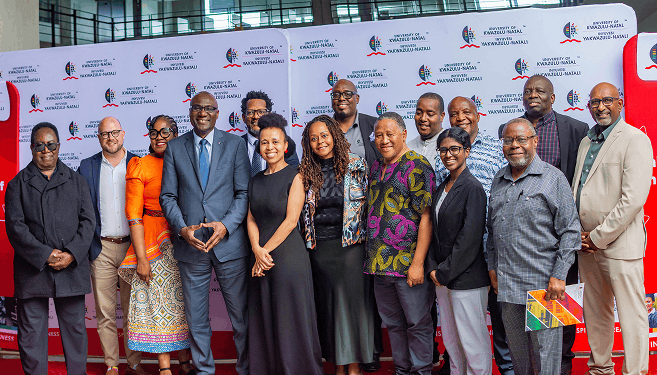
The University of KwaZulu-Natal (UKZN) hosted a delegation from Carleton University in Canada to explore opportunities for academic and research collaboration under a Memorandum of Understanding (MoU) signed by the two institutions in March 2025.
The engagement, held at UKZN’s Westville and Howard College campuses, brought together senior leaders and academics from both institutions to discuss shared priorities, research opportunities and potential areas of co-operation.
Welcoming the Carleton delegation, Executive Director of UKZN’s Corporate Relations Division, Dr Normah Zondo, emphasised the importance of building on the 2025 MoU. The agreement provides a framework for co-operation in education and scientific research, including joint research projects, academic exchanges, student mobility, visiting research scholars, knowledge sharing, symposia, workshops and conferences.
“We therefore see today’s engagement as an opportunity to build on that foundation and translate the commitments in the MoU into meaningful areas of collaboration,” she said.
Zondo also acknowledged Carleton’s contribution to strengthening ties between South African and Canadian universities through the South Africa-Canada Universities Network (SACUN), which Carleton helped establish and continues to anchor in Canada.
UKZN’s Acting Deputy Vice-Chancellor for Research and Innovation, Professor Anil Chuturgoon, outlined the University’s history, research focus areas and strategic priorities, providing context for discussions on shared interests. These included Indigenous research, multiculturalism, diversity, emerging fields of knowledge, knowledge exchange, ethics, inclusive impact and transformation.
Carleton University President and Vice-Chancellor, Professor Wisdom Tettey, outlined his institution’s commitment to partnership, inclusion and social transformation, emphasising the importance of universities working together to achieve a broader global impact.
The discussions also addressed the role of universities in tackling youth unemployment. Both institutions emphasised the need to remain connected to the communities they serve and prepare graduates for the workplace and wider society, including developing leaders who could contribute to job creation.
The engagement also provided an opportunity for both institutions to share knowledge, learn from one another and explore ways to contribute to societal development.
Presentations by UKZN academic leaders introduced the Carleton delegation to the university’s research strengths. Professor Federico Settler, Dean and Head of the School of Social Sciences, outlined areas of mutual interest within the school. UKZN’s Professor Hassan Kaya, Director of the DSTI-NRF Centre of Excellence in Indigenous Knowledge Systems (CEIKS) provided an overview of Indigenous Knowledge Systems and opportunities to develop a collaborative African-Canadian research agenda.
Professor Neil Koorbanally, acting University Dean of Research, highlighted research and innovation opportunities within the College of Agriculture, Engineering and Science.
The discussions also considered opportunities to revive and develop initiatives previously identified by the institutions, including a multidisciplinary winter school focusing on Indigenous Knowledge Systems, traditional health, psychology and multicultural societies.
Potential areas of collaboration included Indigenous Knowledge Systems, traditional medicine, agriculture, social sciences, entrepreneurship, innovation, health and environmental sustainability.
The visit concluded at UKZN’s Howard College campus, where the Carleton delegation toured a traditional medicine research facility and met Professor Nceba Gqaleni, Project Leader: Traditional Medicine, and his team. The delegation also attended a presentation on the team’s research and innovation work.
The visit showcased UKZN’s research capabilities and highlighted opportunities for the University to contribute to international scholarship and societal development.
Both institutions agreed to advance their partnership through collaboration in priority areas, including indigenous knowledge systems, traditional medicine, agriculture, social sciences, entrepreneurship, innovation, health and environmental sustainability.
The engagement supports UKZN’s internationalisation agenda by strengthening partnerships in research, innovation and academic exchange. Both institutions identified opportunities to translate the March 2025 MoU into joint programmes, collaborative research initiatives and knowledge exchange activities that could benefit academics, students and communities in South Africa and Canada.
Words: Lungile Ngubelanga
Photograph: Nkosikhona Gcabhashe