

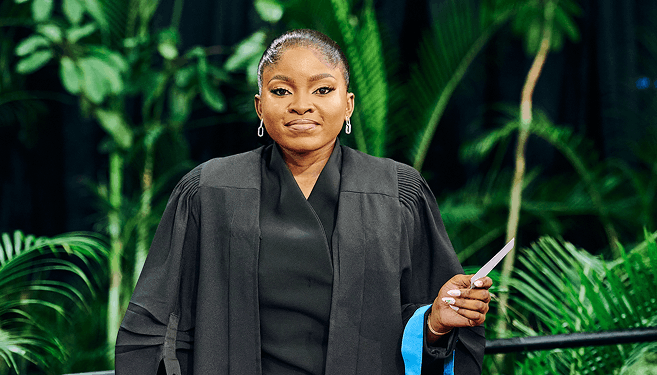
Growing up in KwesakaMthethwa, a rural village in KwaZulu-Natal’s King Cetshwayo District, Ms Nandile Khumalo saw first-hand how poor educational outcomes could shape young people’s futures. Learners at local schools struggled with poor results, some repeating matric elsewhere in the hope of improving their marks, while others dropped out.
These experiences later prompted her master’s research: ‘An Analysis of the Quality of Education in KwaZulu-Natal’s Poor Rural Schools: A Case Study of King Cetshwayo District’, completed under the supervision of Miss Londiwe Jali.
For Khumalo, the pattern was troubling precisely because it had become familiar. “I felt that this should not be normalised in our society,” she said.
Her investigation found that rural education challenges are rooted in more than academic performance. Schools continue to face shortages of teaching and learning materials, inadequate infrastructure, limited access to computer and science laboratories, overcrowded classrooms and shortages of qualified teachers.
Yet her research also uncovered evidence of determination and progress. Learners told Khumalo that they felt prepared to transition to university, while teachers and principals continued working to support good results despite limited resources. In some cases, teachers from other schools assisted with extra classes.
One finding, however, stayed with Khumalo. She found that funding was sometimes allocated to schools late, even though schools have immediate expenses to meet. In some instances, members of school management resorted to using their own money to ensure that activities could continue.
It made her question how schools can be expected to overcome resource constraints when support does not always arrive when it is needed.
“What concerned me was that schools cannot put their needs on hold while waiting for funding,” she said.
The study also showed how structural pressures affect teachers. Heavy workloads can contribute to burnout and, consequently, absenteeism – highlighting the danger of viewing teachers or school management as solely responsible for difficulties that may lie beyond their control.
For Khumalo, quality education means giving every learner access to the conditions needed to succeed: sufficient textbooks, qualified teachers, safe infrastructure and properly equipped computer and science laboratories.
Ultimately, she argues that rural learners should not have to overcome a resource deficit simply because of where they go to school.
“I hope people understand that we should not normalise the challenges faced by rural schools,” she said.
Having grown up in one of the communities at the heart of her study, Khumalo attaches particular meaning to the work. She hopes it will encourage greater attention to the structural realities of rural education and contribute to conversations about creating fairer educational opportunities for learners across KwaZulu-Natal.
Words: Rakshika Sibran
Photograph: Sethu Dlamini