

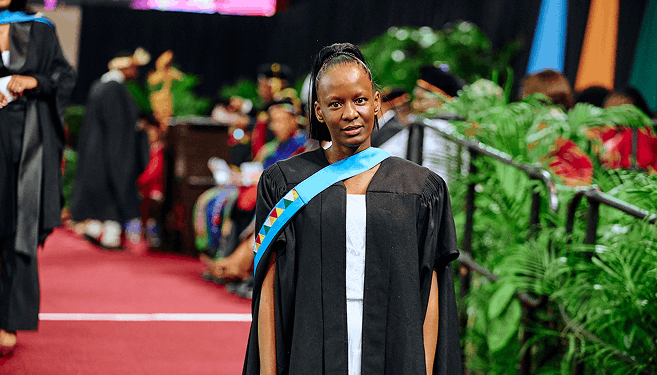
Ms Zamanjomane Langeni’s master’s research began with stories.
Growing up in KwaMaphumulo, she often accompanied her father to KwaDukuza where he would tell her about the history of the town and surrounding areas. Those conversations sparked a question that would eventually become the focus of her academic work: how much of KwaDukuza’s history remains undocumented or overlooked?
Under the supervision of Mr Kuthula Thwala, Langeni investigated: ‘The Depth of History and Heritage of KwaDukuza Area in KwaZulu-Natal, South Africa’, examining the layers of history that have shaped the area and its communities.
Her interest in the subject first developed during her Honours studies in History in 2021, when she began considering the topic: ‘The History of KwaDukuza from the Zulu Perspective’. She discovered that while KwaDukuza is widely associated with King Shaka and Chief Albert Luthuli, its historical significance extends considerably further.
“I became increasingly interested in the stories that are often overlooked and not widely documented,” she said.
Her research revealed a complex heritage shaped by Zulu royal history, colonial settlement, migration, missionary activity, the sugar industry and archaeological heritage. She was particularly struck by the ways in which different communities came to shape the area, including Indian communities whose settlement was connected to the sugar plantations and whose contributions influenced KwaDukuza’s economy, culture and religious life.
The history of sugarcane is particularly visible in the landscape. Langeni noted that farming was an important source of income for many families, while the growth of the sugar industry helped shape the diverse community that exists in KwaDukuza today. Her research also drew attention to lesser-known heritage sites, including Isibhudu Cave and its significant archaeological evidence.
For Langeni, however, preserving heritage means more than protecting recognised sites. It also means recording the memories of the people who lived through the area’s changing history. Her research highlighted the value of oral testimony, particularly as older residents who carry memories of the past become fewer.
“Our heritage is not something that you should know and understand, but it’s something that should be preserved for other generations to come,” she said.
That responsibility extends to younger generations, whom Langeni believes need to understand the history of the places in which they live. Her hope is that KwaDukuza will be seen not simply as a town, but as a place whose heritage connects Zulu history, diverse communities, cultural traditions and significant archaeological and historical sites.
Her own path to the master’s degree has reinforced that sense of perseverance. After completing matric, Langeni spent three years away from formal study before beginning her undergraduate degree at the University of Zululand in 2017. She later completed an Honours degree in History before pursuing her master’s at the University of KwaZulu-Natal (UKZN).
“Through Christ I conquered,” she said, reflecting on a journey that taught her that delays are not necessarily failures, but can form part of the process towards achievement.
She expressed her deepest gratitude to her supervisor and colleagues, as well as to her best friend, Ms Samkelisiwe Musubo, whom she described as “a friend who turned into family”. She thanked them for believing in her and supporting her through difficult moments.
She also dedicated a special word of thanks to her mother: “Dear Mother, thank you for everything you have done for me. I am who I am because of you.”
Langeni hopes her research will encourage a deeper appreciation of KwaDukuza’s history and heritage, particularly among younger generations, so that the stories held in its places and people continue to be remembered.
Words: Rakshika Sibran
Photograph: Tisetso Nhlapo