

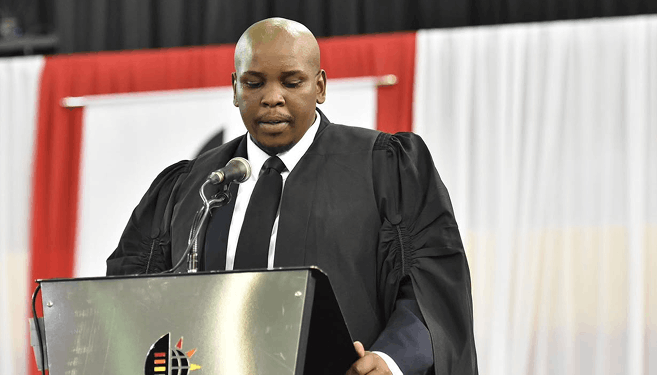
Education is widely regarded as a foundation of democracy. But what happens when the very systems designed to educate citizens begin prioritising economic productivity over civic participation?
It is a tension that lies at the heart of Mr Musawenkosi Dubazana’s research for his Master of Social Sciences in International Relations, ‘Exploring Education as an Enabler of Democracy on a Global Scale’, completed under the supervision of Dr Siyabonga Ntombela.
Dubazana’s research investigated whether education systems around the world are genuinely equipping people to participate critically in democratic life, or whether economic pressures were reshaping education primarily around the needs of the global labour market.
His findings challenged the idea that education and democracy have a simple cause-and-effect relationship. “Education can strengthen democracy, but only if its structural design and institutional priorities intentionally foster democratic capabilities rather than market compliance,” Dubazana said.
While higher levels of educational attainment are generally associated with greater political awareness and stronger democratic expectations, Dubazana discovered that education itself can become a site of inequality and conformity. Increasing emphasis on human capital, vocational efficiency and economically productive disciplines can narrow the purpose of learning, potentially producing individuals who are prepared to function within economic systems but less equipped to question the political and social structures around them.
This became particularly evident in his examination of the language of ‘critical thinking’. Dubazana found that, within market-driven educational frameworks, critical thinking can be reduced to solving problems efficiently – rather than interrogating why those problems exist, who benefits from existing systems and how power is distributed.
“True democratic critical thinking requires questioning why the problem exists in the first place, whose interests the system serves, and how power is distributed,” he said.
The research also transformed Dubazana’s own understanding of education. He explained that he entered the study with the assumption that expanding access to education was inherently beneficial to democratic stability. His investigation instead exposed the limitations of treating democratic education as universal or neutral.
The realities of the Global South, he found, cannot always be adequately understood through Western-centric definitions of democracy and participation. Education can empower citizens, but it can also reproduce social hierarchies and inequality when critical civic consciousness is sidelined.
Dubazana’s academic experience has extended beyond the classroom. His years at the University of KwaZulu-Natal (UKZN) have taken him from student activism into student governance and academic support. His roles have included serving as a Student Representative Council (SRC) member responsible for Residence Affairs across the University’s five campuses, leading the Writing Place Team in the College of Humanities and working as an Academic Development Officer (ADO).
The loss of his uncle during his master’s studies marked a deeply difficult period. Yet his passion for political analysis, commitment to completing his degree and the support of those around him sustained him through the demands of his research.
Dubazana expressed appreciation for the guidance and patience of his supervisor, as well as the unwavering support of the Dubazana family and his friend Mr Senzo Nkumane. He also thanked God for the strength and resilience that carried him through.
Words: Rakshika Sibran
Photograph: Supplied