

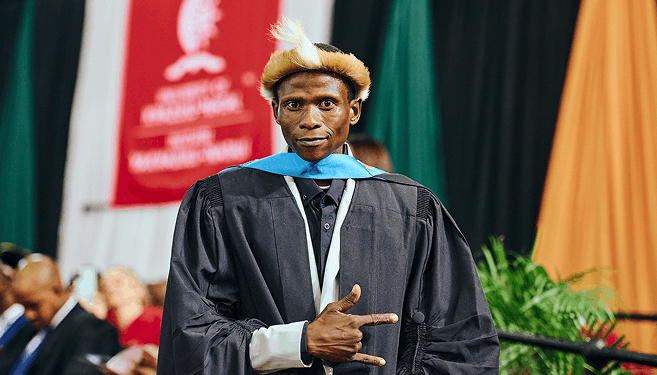
Mr Simphiwe Maphanga recently graduated with a master’s degree from the University of KwaZulu-Natal (UKZN).
His interest in images became the foundation for his research: ‘Rearticulating Cultural Myths Across Time? A Semiotic Comparison of Shaka Zulu (1986) and Shaka iLembe (2023) Television Series Posters and Pilot Episodes’.
Maphanga’s transition from photographer and videographer to researcher began with a question: What lies beneath the images we see? His fascination developed into an interest in understanding how images convey meaning. Questions about why particular images are chosen, how people are positioned and what colours, expressions and objects communicate eventually led him to the study of signs and how meaning is produced and communicated.
The study examines how the figure of Shaka Zulu is represented through visual and narrative signs in the two television productions.
“My analysis considers elements including clothing and regalia, weapons, bodily positioning, facial expressions, landscape, colour, spatial relationships, dialogue and character relationships,” he said.
Maphanga’s research explores whether and how representations of Shaka have changed between the apartheid-era Shaka Zulu and post-apartheid Shaka iLembe, particularly in relation to leadership, power, African identity, cultural memory and historical agency.
His research found that Shaka Zulu is not represented as a fixed historical figure whose meaning remains unchanged. Instead, his image is continually constructed and re-articulated according to different historical, cultural and ideological contexts.
“My study also demonstrates the value of examining promotional posters alongside television narratives, as visual material can establish meanings and expectations that are subsequently developed through storytelling and performance,” he said.
Despite personal challenges, Maphanga completed his master’s degree with distinction.
His supervisor, Professor Lauren Dyll, said: “Simphiwe’s semiotic comparison of the representation of Shaka Zulu across pre- and post-democracy reveals how cultural myths are never fixed, but continually rearticulated to suit their era. His meticulous, image-maker’s eye uncovers how South Africa’s shifting politics reshape our icons – powerful, original work I’m proud to have supervised.”
Maphanga also received support through the UKZN College of Humanities Relief Funding, which he describes as instrumental in making the completion of his qualification possible.
He plans to pursue a PhD and further develop his interests in media, semiotics, representation, African cultural studies and visual culture.
Words: Sinoyolo Mahlasela
Photograph: Sethu Dlamini