

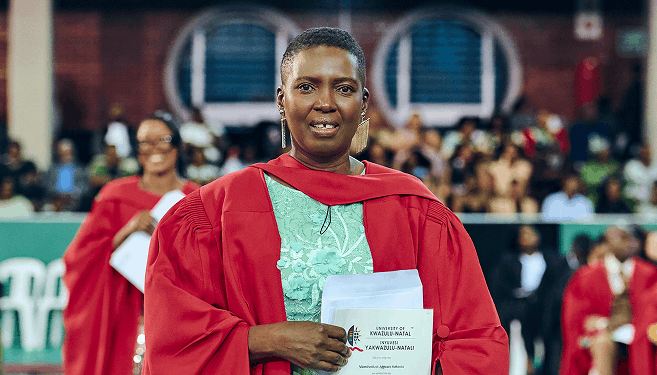
Dr Ntombenkosi Sobantu has graduated with a Doctor of Philosophy in Physiotherapy from the University of KwaZulu-Natal (UKZN), for her study: ‘An Interprofessional Model of Care for Patients with Pelvic Fractures in Academic Hospitals within Tshwane, South Africa’, marking the culmination of a journey driven by a desire to improve the quality of rehabilitation care for patients with complex pelvic fractures.
Supervised by the award-winning Head of the Department of Physiotherapy Professor Verusia Chetty, Sobantu’s doctoral research focused on developing a context-specific, interprofessional model of care for the rehabilitation of individuals with pelvic fractures in Tshwane academic hospitals.
Pelvic fractures are among the most complex injuries to manage because of their association with damage to surrounding anatomical structures and organs. While patients may survive the initial trauma, many experience long-term disability, reduced functional independence and diminished health-related quality of life. These challenges can affect their ability to return to work, participate in their communities and resume everyday activities.
Her study employed an exploratory sequential mixed-methods design conducted in three phases. These included a scoping review and semi-structured interviews with healthcare professionals and patients, followed by a Delphi technique involving expert consensus and the development of a rehabilitation model.
The research identified four key components essential to improving care: principles of rehabilitation and professional training; organisational structures and resource allocation; defined levels of care and clinical pathways; and comprehensive, patient-centred rehabilitation strategies supported by standardised outcome measures.
The resulting model provides detailed guidelines for stakeholders to adopt within South Africa’s public healthcare sector. Grounded in a biopsychosocial approach, it promotes co-ordinated, patient-centred rehabilitation across all three levels of care, while strengthening interprofessional collaboration, continuity of care and the integration of rehabilitation services across healthcare settings.
According to Sobantu, the research is the first of its kind in South Africa to develop a context-specific interprofessional rehabilitation model for patients with pelvic fractures. The model has the potential to address gaps in rehabilitation through standardised care pathways, improved co-ordination, more equitable access and the efficient use of limited rehabilitation resources and personnel.
Her interest in the field began when she was working as a clinician and observed that although patients with pelvic fractures were relatively few, they often required longer hospital stays and more complex rehabilitation. As an academic and clinical supervisor, she continued to question what happened to these patients after discharge and how their injuries affected their quality of life and ability to resume everyday activities.
“What started as an observation in clinical practice ultimately developed into a deeper desire to understand the experiences and outcomes of these patients and, hopefully, contribute to improving the rehabilitation they receive,” she said.
Born and raised in a rural area of the Eastern Cape, Sobantu is the second of five siblings. Her journey into healthcare was inspired by a family doctor who cared for her community and later helped her secure a bursary to pursue her studies when financial constraints threatened to limit her opportunities.
Now a lecturer in the Department of Physiotherapy at Sefako Makgatho Health Sciences University, Sobantu teaches musculoskeletal conditions and orthopaedic rehabilitation while helping to prepare future physiotherapists for clinical practice.
Reflecting on her PhD achievement, she described it as an “incredible milestone” and the fulfilment of a long-held dream. “There were certainly challenges along the way, but overcoming them has made this achievement even more meaningful,” she said. “I am proud that my research contributes to knowledge in my field, and I hope it will have a positive impact beyond academia.”
Having published aspects of her research in peer-reviewed journals, presented at local and international conferences and received a Best Student Oral Presentation award, Sobantu hoped her journey will inspire others to pursue their dreams.
Chetty congratulated Sobantu: “It has been an absolute privilege to supervise Dr Ntombenkosi Sobantu throughout her PhD journey. Her research addresses an important gap in rehabilitation within South Africa by developing the country’s first context-specific interprofessional model of care for the rehabilitation of patients with pelvic fractures in the public healthcare sector.”
“Ntombenkosi demonstrated exceptional dedication, resilience, and academic maturity throughout her doctoral studies. She successfully conducted a rigorous mixed-methods study, bringing together the voices of patients, healthcare professionals, and experts to produce research that is both scientifically robust and highly relevant to clinical practice and health policy,” said Chetty.
Words: MaryAnn Francis
Photograph: Sethu Dlamini