

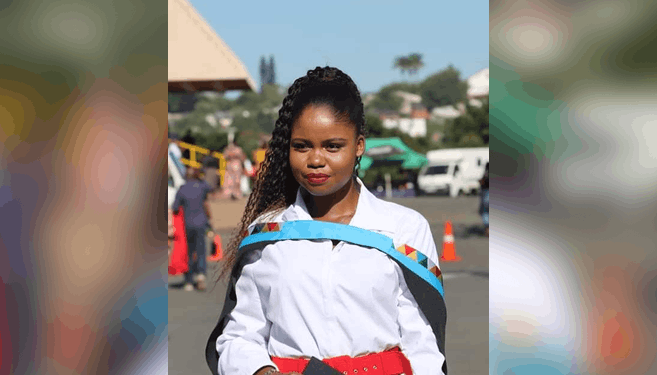
While working as an assistant teacher at a primary school during her honours studies in 2021 and 2022, Ms Siphesihle Mtolo began noticing connections between the media learners enjoyed and the ways in which some of them spoke about violence.
Conversations with learners during lessons and lunch breaks gave her an opportunity to understand how they thought, behaved and engaged with the world around them.
That experience became the starting point for her master’s research: ‘Exploring the Perceived Influences of Violent Media on Adolescent Behaviour: A Case Study of uMkangala Learners at uMzimkhulu, KwaZulu-Natal’, supervised by Dr Londeka Ngubane.
Mtolo found that learners did not necessarily regard violent films and television programmes as directly making them violent. Instead, many saw them as providing strategies for dealing with violence they already encountered in their communities.
“They said violent media doesn’t make them violent but it motivates them to use violence,” she explained.
The research indicated that action films could be particularly influential. Learners mentioned films such as Fast & Furious and John Wick, with their appeal extending beyond the action itself to the lifestyles and rewards associated with the protagonists: respect, revenge, wealth, luxury cars and homes, and the sense of victory that comes with achieving a goal.
One conversation with a 13-year-old learner, however, stayed with Mtolo in particular. The learner told her that she enjoyed horror films and was drawn to frightening scenes. The response made Mtolo reflect on how adolescents process what they see on screen and how their understanding of violent content is shaped by their own experiences.
The encounter prompted her to seek further perspectives from the learner’s educators and reinforced her view that greater attention should be paid to what young people watch and how they interpret it.
“It was a bit too sensitive and shocking coming from a 13-year-old,” Mtolo recalled.
Her research suggested that learners were able to distinguish between entertainment and reality, but their understanding of violence was also influenced by what they witnessed in their communities and when visiting family and friends. Some viewed the violent strategies portrayed in films as useful for defending themselves, while violence itself could become normalised as a way of responding to conflict.
For Mtolo, this makes the role of parents, teachers and communities particularly important. She hopes her research encourages adults to look beyond the assumption that violent content is simply entertainment and to take age restrictions and young people’s responses to what they watch seriously.
“Media violence and any other viewed content doesn’t just entertain but it also educates,” she said.
Her own journey has strengthened her interest in crime investigation and teaching. Currently working as an administrator in the construction sector, Mtolo continues to pursue short courses and is developing an interest in cybersecurity. She hopes to become a crime investigator or lecturer and ultimately establish businesses of her own.
She thanked God for giving her strength, guidance and direction throughout her academic journey. She also expressed her gratitude to her mother, whom she described as her “pillar of strength” for continually encouraging her never to give up on her studies. She also acknowledged the principal of the school where she conducted her research for his support.
For her next chapter, Mtolo remains interested in crime investigation, teaching and the questions that connect society, behaviour and young people’s lives.
Words: Rakshika Sibran
Photograph: Supplied