

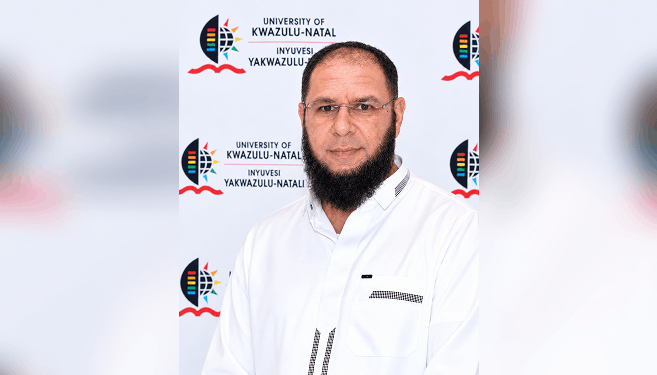
Professor Ozayr Mahomed, Adjunct Associate Professor in Public Health Medicine at the University of KwaZulu-Natal (UKZN), has received a C2 rating from the National Research Foundation (NRF) in recognition of his sustained contribution to public health, health systems strengthening, and health services research.
The achievement is particularly significant for Mahomed as it was his first application for an NRF rating, with the assessment reflecting his research contributions and outputs up to the end of 2024.
“I am deeply grateful for the C2 rating, particularly as this was my first application. Research is rarely an individual journey, and I see this recognition as shared with the many postgraduate students, colleagues, health-service managers, clinicians and collaborators who have contributed to the work over the years,” he said.
A defining feature of his work has been translating research into health policy and service delivery. Mahomed was the lead author or technical architect of seven major national health-system frameworks and policies adopted and operationalised through South Africa’s National Department of Health. His work has included integrated chronic disease management, referral systems, clinical governance, patient safety, primary healthcare quality, and district health service strengthening.
“For me, the value of public health research is ultimately in whether it contributes to better health systems and better outcomes for people. Publishing is important, but research becomes especially meaningful when evidence informs policy, improves service delivery or helps strengthen the capacity of health systems,” he said.
His research has increasingly extended beyond South Africa. He has collaborated on health research and health-system projects across Africa and the Gulf region, including work in Kuwait, Saudi Arabia and the United Arab Emirates, and is a Global Burden of Disease Collaborator.
Additionally, Mahomed served as Senior Scientist Epidemiologist at the Dasman Diabetes Institute in Kuwait, where his work included diabetes epidemiology, population health, and the Kuwait National Diabetes Registry. He contributed to public health preparedness and health-system resilience for Hajj through the Global Centre for Mass Gathering Medicine in Riyadh.
Mahomed completed his Bachelor of Medicine and Bachelor of Surgery (MBChB), Master of Medicine (MMed), and PhD at UKZN. He has held leadership responsibilities in undergraduate Public Health teaching, Public Health Medicine specialist training, postgraduate education and research. In 2023, he was recognised as one of UKZN’s Top 30 researchers. His scholarly profile includes more than 100 peer-reviewed publications, an h-index of 17, and more than 1 500 citations, together with the supervision or co-supervision of more than 50 master’s and 10 doctoral candidates.
He regards postgraduate supervision and mentorship as an important component of his academic contribution. “One of the greatest privileges of academic work is seeing students develop into independent researchers and leaders. Many of the students I have supervised have investigated real health-system challenges across South Africa and other African countries. Building the next generation of researchers is as important to me as producing research myself.”
He views the C2 rating as a platform for the next phase of his research rather than an endpoint. “The rating encourages me to become even more focused on research that strengthens resilient and equitable health systems, integrated care, implementation science, population health and responsible digital innovation. I also hope to continue developing research capacity and strengthening international collaborations.”
Mahomed expressed his appreciation to his mentors, students, colleagues and research collaborators at UKZN and internationally for their contribution to his academic journey.
Words: Lunga Memela
Photograph: Supplied