

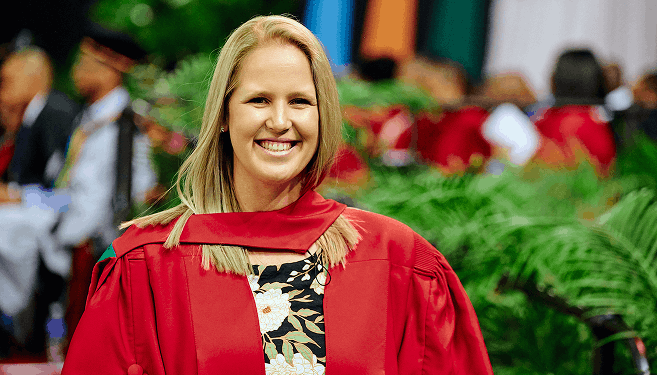
Dr Cassidy-Mae Shaw’s doctoral study, ‘Addressing Challenges Trainee Psychologists Face in Conducting Clinical Assessment Interviews: A Programme Implementation and Evaluation Approach Using a Competency Based Framework’, investigated how trainee psychologists can develop the competence, confidence and flexibility needed to conduct clinical assessment interviews.
Conducted under the supervision of Professor Duncan Cartwright, the research explored what happens when carefully learned theory meets the unpredictable reality of another person sitting in the room.
The question emerged from her own clinical training. During her internship and community service placements, Shaw encountered markedly different clinical settings and began noticing a gap between how clinical skills are taught and how they must be applied in practice. “Theory can give you the map but the contours of the real landscape of clinical practice are a whole different thing,” she said.
A clinical assessment interview asks a great deal of a novice psychologist. They must listen, formulate, build rapport, make decisions, manage themselves and respond ethically, often simultaneously. For trainees being assessed during their master’s training, there is the added pressure of wondering not only what their patient thinks of them, but whether their own performance signals their suitability for the profession.
Shaw likens the experience to “having to perform a choreographed dance for which you have only been given stick-figure drawings demonstrating the moves”.
Her research investigated how that complex skill could be taught differently. She developed and evaluated a training programme combining competency development, deliberate practice and reflection, including the CHART Reflective Model.
One of the study’s biggest surprises was discovering how many smaller, interconnected competencies sit beneath clinical interviewing. The more she investigated, the more intricate the skill became – reshaping her understanding of how clinical expertise should be taught.
“The more I unpacked the clinical skill of interviewing, the more intricacies and foundations I found underneath it as both a skill and an experience,” Shaw said.
She also investigated the relationship between confidence and competence, finding that the two do not develop in a simple sequence. Deliberate practice helps trainees refine specific skills and adapt to different scenarios, while reflection encourages them to consider not only what they did, but why.
Now a Principal Clinical Psychologist at Grey’s Hospital in Pietermaritzburg, Shaw has increasingly focused her clinical work on health psychology and burns care.
She credits Cartwright’s belief in her with giving her the opportunity to undertake the project and discover her passion for research. She also thanks her family for supporting her through the late nights, stress and countless conversations about clinical assessment interviews – as well as an “endless supply of cups of tea and encouragement”.
Her PhD became affectionately known as ‘the elephant’ at home. With graduation, that elephant has finally left the room.
For Psychology students preparing for their first clinical interview, Shaw’s advice is simple: practise extensively, but do not practise for perfection. “Practice is not about building the perfect script. It is about developing the skills and flexibility to respond when reality inevitably throws the script away,” she said.
Words: Rakshika Sibran
Photograph: Tisetso Nhlapo