

South Africa does not lack disaster policies – it lacks the integrated, cross-sector implementation that would prevent the same communities from being devastated again and again. Every time disaster strikes in South Africa, there is the familiar clamour for a state of disaster declaration. Once the relevant minister or the president obliges, emergency funds are mobilised, relief agencies spring into action, political bigwigs roll into affected communities, and, once again, we hear the same promises of restoration and rebirth. Yet once the floodwaters recede, the fires are extinguished, the drought relents and the epidemic is broken, one uncomfortable question remains: Why do disasters visit the same communities again and again? The answer is simple but uncomfortable.
South Africa does not suffer from a shortage of disaster policies. It suffers from a lack of integrated responses, and from legislation that could be better interpreted and implemented. The Disaster Management Act (Act 57 of 2002) and the National Disaster Management Framework were never intended to make disaster management the sole responsibility of disaster management centres. The act envisioned a whole-of-government approach in which every sector – from housing and transport to water, health, planning and environmental management – shares responsibility for reducing risk before disasters occur.
Unfortunately, this vision remains misunderstood and therefore largely unrealised. Consequently, disaster management sits at the margins of government rather than at the centre of development planning. Municipal Integrated Development Plans (IDPs), Spatial Development Frameworks (SDFs), infrastructure investment programmes and housing strategies frequently operate in isolation from disaster risk assessments. As a result, communities continue to be settled on floodplains, drainage systems remain under designed, informal settlements expand into hazardous areas, and infrastructure is rebuilt only to fail again during the next extreme event. Disasters are therefore not simply natural events; they are the visible consequences of fragmented governance. As climate change drives more frequent devastation, our governance weaknesses are exposed.
According to the World Meteorological Organisation, Africa is warming faster than the global average, with southern Africa facing growing risks from extreme heat, drought and heavy rainfall. South Africa’s recent experience makes the warning difficult to ignore. The 2017 Knysna fires destroyed more than 1 000 homes and claimed seven lives. The prolonged 2015-2018 drought in the Western Cape pushed Cape Town towards ‘Day Zero’, placing the water security of millions under extraordinary pressure. In April 2022, catastrophic floods in KwaZulu-Natal claimed more than 440 lives, displaced tens of thousands, destroyed or damaged thousands of homes and caused enormous damage to public infrastructure. Severe floods and storms have also affected communities in the Eastern Cape, Limpopo, Mpumalanga, North West, the Free State, and other parts of the country.
Different provinces. Different hazards. Different years. But many of the underlying vulnerabilities are remarkably similar. The devastation is not solely a function of a disaster’s severity. It is the consequence of years of spatial inequality, ageing and poorly maintained infrastructure, settlements in high-risk areas, weak co-ordination between institutions, environmental degradation, and historical planning decisions that continue to shape who is most exposed when disaster strikes. The floodwaters, fires and droughts merely exposed vulnerabilities that were already there. Integrated disaster management, therefore, requires far more than emergency response co-ordination. It requires disaster risk reduction to become a routine consideration in every development decision.
When roads are designed, engineers should consider present and future climate risks. When human settlements are planned, flood susceptibility and other hazards should shape decisions about where and how development occurs. When municipalities prepare budgets, investment in prevention and infrastructure resilience should receive serious attention alongside disaster response and recovery. When a bridge is rebuilt after being washed away, we should not simply ask how quickly it can be replaced. We should ask whether we are rebuilding it differently, whether the underlying risk has changed, and whether the new infrastructure can withstand the conditions we increasingly expect. Otherwise, we are not rebuilding resilience. We are rebuilding risk. The challenge is not simply technical. South Africa possesses highly capable scientists, planners, engineers, climate specialists, disaster management practitioners and researchers. The challenge is also institutional.
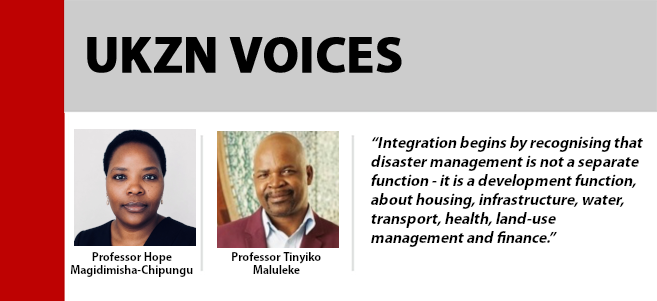
Government departments often work in silos, each pursuing sectoral mandates with limited opportunities or incentives for sustained collaboration. Information is collected but not always shared effectively. Risk assessments are undertaken, but are not consistently translated into planning and investment decisions. Climate information may sit in one institution, infrastructure information in another, settlement information somewhere else, and disaster risk information in yet another. The information exists. The expertise exists. The institutions exist. But are they sufficiently connected? Integration begins by recognising that disaster management is not a separate function – it is a development function, about housing, infrastructure, water, transport, health, land-use management and finance. And fundamentally, it is about how and where we plan our settlements. This also requires a shift in how success is measured.
Municipalities and disaster management institutions are often judged by how quickly they respond when disaster strikes. Yet perhaps the more important measure should be how effectively disasters are prevented from becoming catastrophes in the first place. What does successful disaster management look like? We will know we have succeeded when bridges remain standing during and after a storm, when drainage systems continue to function during extreme rainfall, when communities – including informal settlements on exposed land – receive early warnings and know exactly what to do, and when infrastructure budgets prioritise prevention so that costly reconstruction may be avoided.
In short, we succeed when we plan in anticipation of risk rather than react only after tragedy has struck. Building resilience is not only about responding faster; it is also about planning smarter. International evidence reinforces the economic case for prevention. The United Nations Office for Disaster Risk Reduction has repeatedly emphasised that investing in disaster risk reduction and resilient infrastructure can generate substantial savings by avoiding future disaster losses. This matters enormously in South Africa. Every rand repeatedly spent repairing the same road, replacing the same bridge or rebuilding infrastructure in the same vulnerable location is a rand that cannot be invested elsewhere in development.
Prevention is therefore not merely a disaster management tactic; it is an economic development strategy. Communities should no longer be viewed primarily as recipients of disaster assistance. Instead, they should be recognised as active partners in both the reduction and the management of risk. Residents often know exactly where water accumulates after heavy rainfall. They know which drains are repeatedly blocked, which roads become inaccessible, which river crossings become dangerous and which households contain elderly people, children or persons who may require additional assistance during an emergency. Integrating community knowledge with scientific data, spatial information and technical modelling produces a much richer understanding of risk and leads to interventions that respond to the realities people experience on the ground. South Africa has already developed many of the legislative, policy and institutional instruments needed to support integrated disaster management. What is missing is stronger implementation, institutional accountability and leadership that actively rewards collaboration across sectors and spheres of government.
This is where an important national conversation needs to begin. Recognising that South Africa’s greatest disaster management challenge may not be the absence of policies but the fragmentation of their implementation, the National Planning Commission (NPC) will convene a Dialogue on Integrated Disaster Management and Climate Change in October. The Dialogue will bring together key government departments and institutions involved in disaster management, climate change adaptation and development planning. It is not intended to produce all the answers in a single day. Instead, it seeks to start a national conversation about strengthening collaboration, improving co-ordination and ensuring that disaster risk reduction becomes everyone’s responsibility – not only that of disaster management practitioners.
Professor Hope Magidimisha-Chipungu is an academic in Town Planning at UKZN and both Magidimisha-Chipungu and Professor Tinyiko Maluleke are National Planning Commissioners in the Department of the Presidency of South Africa.
*The views and opinions expressed in this article are those of the author and do not necessarily reflect the official policy or position of the University of KwaZulu-Natal.
*This article was originally published in News24: ANALYSIS | Why Our Disaster Management System is Often Disastrous | on 17 August, 2026.