

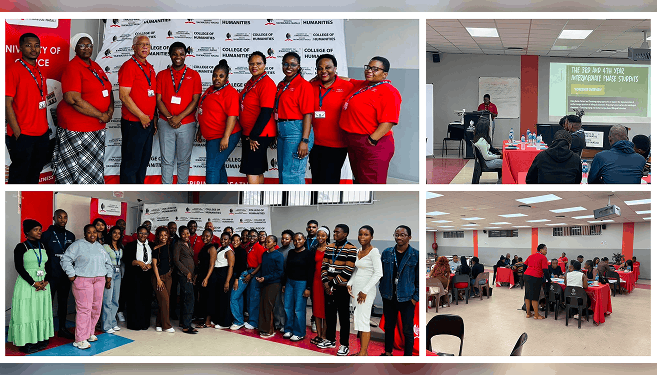
The University of KwaZulu-Natal (UKZN) hosted a professional development workshop recently at its Edgewood campus to equip pre-service teachers with practical strategies for teaching in multilingual Intermediate Phase classrooms.
The workshop formed part of the research project, ‘Using Socio-Cultural and Translanguaging Approaches to Support the Implementation of Mother-Tongue Practices in Bilingual Classrooms: Preparing Future Teachers for Multilingual Classrooms – Translanguaging and Mother-Tongue-Based Bilingual Education’.
Led by principal investigator Ms Khanyi Mbambo, with Mr Mlungisi Vusumuzi Hlabisa and Mr Eugene Marais as co-investigators, the project seeks to address persistent challenges in implementing Mother-Tongue-Based Bilingual Education (MTbBE) in the Intermediate Phase. The research team also includes field researchers Dr Barbara Goba, Dr Zanele Zama, Dr Muhle Sibisi, Mr Yongama Mdleleni, Ms Thulile Ndlovu, and Ms Nontle Diya.
The workshop brought together 30 Intermediate Phase pre-service teachers who had experienced MTbBE implementation during their teaching practice. It focused particularly on translanguaging, an approach that enables teachers and learners to draw strategically on their full linguistic repertoires to support understanding, participation, meaning-making, and knowledge development.
“The project addresses the need to move beyond seeing multilingualism as a challenge and instead recognise it as a valuable resource for learning,” said Mbambo.
The programme combined theoretical engagement with practical classroom applications. Students explored the importance of mother-tongue education and examined MTbBE, the Basic Education Laws Amendment (BELA) Act, and the Language-in-Education Policy (LiEP).
Marais and Mdleleni facilitated discussions on multilingual pedagogy and language policy, while Goba and Sibisi demonstrated translanguaging strategies through Mathematics and Natural Sciences lesson plans. These sessions enabled students to consider how bilingual approaches can support the teaching and learning of both language and content subjects.
Zama then facilitated a collaborative lesson-design activity in which students applied the concepts explored during the workshop. The lessons incorporated translanguaging, dialogic teaching and collaborative learning to promote learner participation, communicative competence and conceptual understanding.
The workshop also gave students an opportunity to reflect on their experiences and challenges in implementing MTbBE during teaching practice. Mbambo said reflective research discussions, collaborative lesson planning, and debates formed part of the project’s systematic data-collection process.
“The findings will inform qualitative analysis and contribute to recommendations for the professional development of pre-service and in-service teachers on the practical implementation of Mother-Tongue-Based Bilingual Education through translanguaging,” she said.
The project will further contribute to the development of sample lesson plans, assessment tools and teaching materials that support bilingual teaching practices.
According to Mbambo, the initiative reflects UKZN’s commitment to advancing multilingual education through research, innovation and community engagement. “It positions higher education institutions as spaces where multilingualism is not a problem to be overcome, but a resource through which knowledge can be accessed, constructed and shared,” she said.
Words: NdabaOnline
Photographs: Supplied