

Click here for isiZulu version
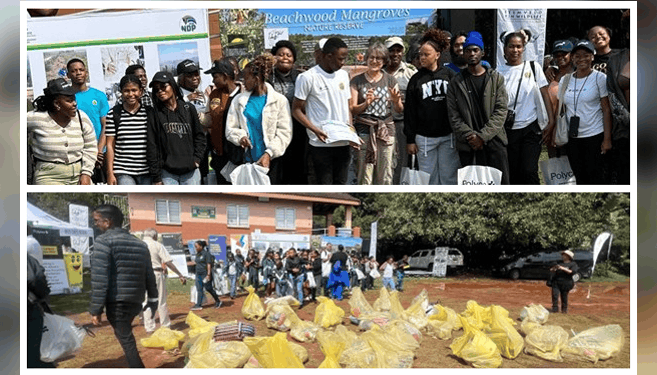
Students from the University of KwaZulu-Natal (UKZN) Marine Life Club joined hundreds of volunteers for the 2026 International Coastal Clean-up (ICC).
Co-ordinated globally by Ocean Conservancy, the annual ICC brings together volunteers to remove litter from beaches and waterways and record the types of debris collected. The information contributes to a global marine debris dataset, helping researchers understand pollution sources and patterns. Since the programme began in 1986, nearly 20 million volunteers have participated, removing approximately 181 million kilograms of waste worldwide.
The 2026 ICC was collaboratively organised by the North Durban KZN Wildlife Conservation Honorary Officers and the Department of Forestry, Fisheries and the Environment (DFFE). For the UKZN Marine Life Club, the event offered an opportunity to put marine science into practice. The student organisation brought marine biology students to Beachwood to help protect the coastal environment.
Participants included schoolchildren, university students, conservation professionals and community members. Their involvement highlighted the shared responsibility of scientists, conservation organisations and the public to protect the ocean.
Heavy rainfall had washed litter onto the Beachwood shoreline before the clean-up, highlighting the connection between activities on land, stormwater systems, rivers, estuaries and the ocean. Pollution entering waterways can reach the coast, making effective waste management throughout river catchments essential to marine conservation. During the event, 1 200 participants collected eight tonnes of litter along 500 metres of coastline in two hours.
The event also provided opportunities for environmental education. Professor Ursula Scharler, a marine biology specialist from UKZN’s School of Agriculture and Science, and Professor Akash Anandraj, an estuarine and nature conservation specialist at Mangosuthu University of Technology and a UKZN alumnus, addressed participants. Both highlighted the ecological importance of clean coastal environments and continued public involvement in protecting marine biodiversity.
Mr Trevor Govender, a PhD candidate at UKZN and a KZN Wildlife Conservation honorary officer, served as programme director, co-ordinating proceedings and facilitating engagement between participants and speakers.
The Deputy Minister of Forestry, Fisheries and the Environment, Mr Narend Singh, delivered a keynote address on protecting South Africa’s coastline and marine environment.
Singh and Ms Vuyi Radebe, executive manager for biodiversity at Ezemvelo KZN Wildlife and UKZN alumna, presented certificates of appreciation to participating partners and sponsors.
The UKZN Marine Life Club received a certificate recognising its contribution to the clean-up and its students’ involvement in practical environmental conservation.
For the students, the day showed how scientific knowledge, community participation and practical conservation can work together. They worked alongside schoolchildren and older community members, demonstrating that marine conservation extends beyond laboratories, research papers and lecture theatres to beaches, estuaries, wetlands and communities.
Ocean Conservancy’s 2025 clean-up results recorded more than 1.3 million plastic beverage bottles and nearly 886 000 plastic caps collected worldwide. These figures illustrate the scale of marine litter. Plastic discarded inland can travel through stormwater systems, rivers and estuaries to the coast. Removing litter before it reaches the ocean can help protect habitats and wildlife.
The event highlighted the importance of combining scientific knowledge with public action to protect marine environments.
At Beachwood, the students chose to act – one piece of litter at a time.
Said Scharler: “Picking up litter is one way of environmental stewardship; during such public events people also learn that removing litter isn’t just about removing an eyesore, but about cleaning the environment for the thousands of other species inhabiting the coast. Ultimately, they are our life support system.”
Words: NdabaOnline
Photographs: Supplied