

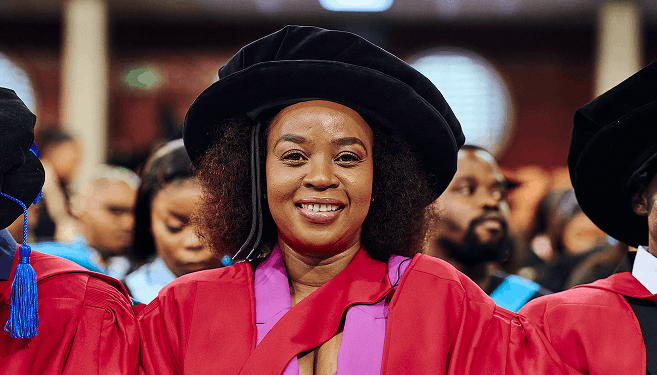
Dr Thembelihle Luthuli completed her PhD on depression among isiZulu-speaking South Africans, examining the social and economic factors associated with depression and how people understand, recognise and respond to it.
Her academic background in Population Studies sparked her interest in how people’s health and wellbeing are influenced by their social and economic circumstances. This developed into a particular focus on depression and the factors that shape people’s experiences and understanding of mental health.
Luthuli focused on isiZulu-speaking South Africans as a defined population, seeking to contribute evidence that could encourage further research across different linguistic and cultural settings. “My background in Population Studies developed my interest in how people’s health and wellbeing are shaped by their social and economic circumstances,” she said.
The study combined longitudinal data from isiZulu-speaking participants across South Africa, with qualitative interviews conducted in one urban and one rural setting in KwaZulu-Natal.
This approach enabled Luthuli to examine patterns associated with depression over time while also exploring how depression is understood within particular social, cultural and linguistic contexts.
A significant finding was that socioeconomic circumstances, including employment and expectations about future economic position, were associated with the likelihood of experiencing depressive symptoms.
Luthuli’s findings further revealed that participants did not necessarily identify the symptoms presented to them as depression. Instead, some described their experiences using terms such as ‘stress’, while their explanations and responses were influenced by social, cultural and relational factors.
Luthuli said the findings highlighted the importance of looking beyond clinical understandings of depression.
“Participants did not necessarily describe these experiences using biomedical terminology. Their responses showed the importance of understanding how mental health is interpreted within people’s social, cultural and linguistic contexts,” she said.
She hopes the research can contribute to mental health interventions and communication that are more responsive to the communities they serve, while highlighting the importance of addressing wider social and economic conditions associated with mental health.
One of the most difficult moments was losing her mother during her studies. Continuing with the PhD while dealing with such a significant personal loss was not easy, and there were times when her progress was affected.
However, her studies were supported by the UKZN Talent Excellence and Equity Acceleration (TEAEA) scholarship, which provided financial and mentorship support. She was also awarded the University of Michigan African Presidential Scholars (UMAPS) fellowship, providing an opportunity to spend a semester at the University of Michigan in Ann Arbor in the United States.
Luthuli also expressed gratitude to her supervisor Dr Kerry Vermaak for the guidance and support provided throughout the PhD. Looking beyond graduation, Luthuli plans to develop publications from the research and share the findings with wider academic and professional audiences. She is also interested in continuing research on mental health within African contexts.
Her advice to postgraduate researchers is to accept that the process will not always be smooth. “Do not allow a difficult or unproductive period to convince you that you cannot finish. Learn to return to the work and keep going,” she said.
Words: Sinoyolo Mahlasela
Photograph: Sethu Dlamini