

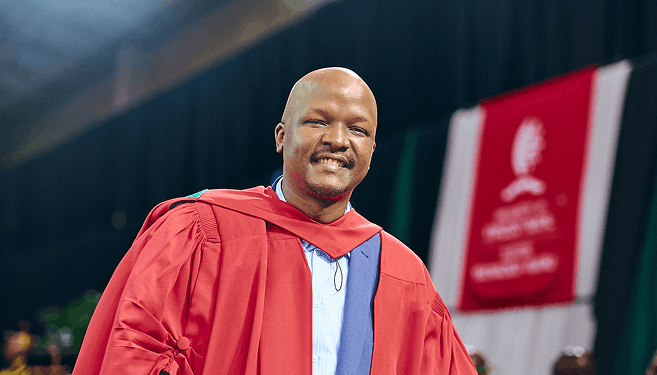
For Dr Usangiphile Evile Buthelezi, the journey from KwaHlabisa in KwaZulu-Natal to earning a PhD in Public Health at the University of KwaZulu-Natal (UKZN) has been driven by a desire to understand how health systems can better serve the communities they are designed to support.
Buthelezi graduated with a PhD in Public Health for his novel study, ‘A Realist Evaluation of the Roles and Functions of Community Health Workers in Service of Integrated, People-Centred Care’.
He was supervised by public health scientist Dr André J van Rensburg, based at UKZN’s Centre for Research in Health Systems, and Professor Mosa Moshabela, Vice-Chancellor of the University of Cape Town.
His research explored how community health workers (CHWs) can be optimised to strengthen integrated and people-centred health systems.
A key finding was that CHWs should not be viewed simply as extensions of basic health services. Instead, they function as important ‘boundary spanners’ connecting households, clinics, the broader health system and other government and social sectors.
At household level, the study found that CHWs contribute to people-centred care by building trusting relationships, understanding community members’ circumstances and priorities, supporting treatment and service uptake, facilitating referrals and maintaining continuity between households and health services.
However, their effectiveness depends on more than simply assigning responsibilities. Trust, motivation and professional legitimacy emerged as important mechanisms influencing their ability to perform their roles, while supportive supervision, recognition, adequate resources and institutional support were critical enabling conditions.
Buthelezi also examined CHWs within Operation Sukuma Sakhe, KwaZulu-Natal’s intersectoral governance system. The research showed that CHWs often act as links between communities and sectors such as health and social services. However, structures such as War Rooms do not automatically result in integrated care.
Where accountability, role clarity, participation and institutional responsiveness are weak, cases may remain unresolved, leaving CHWs to compensate for shortcomings in the wider system and sometimes take on responsibilities beyond their formal roles.
The study makes a theoretical contribution by reconceptualising the World Health Organization’s (WHO) Integrated People-Centred Health Services framework through a mechanism-sensitive lens.
It demonstrates that integration depends not only on structures and policies, but also on the relationships and mechanisms that allow those structures to function effectively in specific contexts.
Buthelezi described the research as novel, noting that it is the first known study to apply realist evaluation across the entire WHO Integrated People-Centred Health Services framework using CHWs as the entry point of analysis.
The study culminated in a realist-informed Theory of Change, offering practical recommendations including professional recognition for CHWs, clearer roles and accountability, appropriate resourcing, broader training, supportive supervision, stronger intersectoral governance and integrated referral and information systems.
Buthelezi’s interest in health systems was shaped by a desire to understand why sound policies and services do not always translate into positive experiences and outcomes for communities.
His academic journey began with Biomedical Sciences at UKZN, followed by an honours qualification in Medical Microbiology and a Master of Medical Sciences specialising in Spatial Epidemiology. His early research experience, including work at the Centre for the AIDS Programme of Research in South Africa (CAPRISA), exposed him to HIV research, disease surveillance and population health.
Buthelezi is a Research Associate at UKZN’s Centre for Research in Health Systems, where he works at the intersection of community health systems, policy and collaborative governance.
He credited his late parents and his fiancée, Ms Ziyanda Ndaba, for providing motivation and support throughout his doctoral journey.
“My PhD was completed by publication and has already resulted in several peer-reviewed publications,” said Buthelezi, whose work has appeared in Social Science & Medicine, SSM Health Systems and PLOS Global Public Health.
Van Rensburg congratulated Buthelezi: “Many congratulations Sah on this life-changing achievement. And remember to – in realist terms – not only – focus on the outcome, but to embody the process as well, and to take pride in how this PhD was achieved, despite existential challenges. Here’s to a lifetime of success – this is only the beginning! All the best, André.”
Words: MaryAnn Francis
Photograph: Sethu Dlamini