

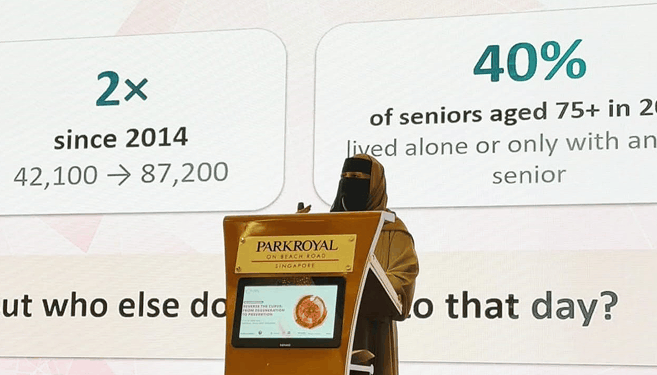
“We need to challenge conventional approaches to eye examinations,” the University of KwaZulu-Natal’s (UKZN) Head of Optometry Dr Naimah Khan told an international conference in Singapore.
Khan received a Certificate of Appreciation from the Singapore Optometric Association (SOA) for her participation as an invited speaker at the conference.
Held under the theme: ‘Reverse the Curve: From Degeneration to Prevention’, the conference brought together optometrists, researchers and allied eye care professionals to explore approaches that prioritise prevention, early detection and proactive eye health management.
Khan’s presentation was titled: ‘They Came for Glasses. They Needed a Conversation: The 40+ Patient in Your Chair’, drawing on perspectives from South Africa’s public eye health context to emphasise the importance of looking beyond prescriptions when caring for ageing patients.
Khan said: “We need to challenge conventional approaches to eye examinations. Meaningful conversations can help practitioners identify potential red flags, understand patients’ broader needs and provide more compassionate, person-centred care.”
Her key message was: “The spectacle may correct the blur; the conversation can change the care.”
Khan also participated in two panel discussions: ‘To Prescribe or Not to Prescribe: The Ageing Eye’ and ‘More Patients, More Needs, More Disruption: What Does the Next Decade Actually Look Like for Us?’
The discussions explored how optometry needs to respond to demographic shifts, technological advances and increasingly complex patient needs while preserving the human connection essential to healthcare.
Drawing on South Africa’s public eye health challenges, Khan underscored the importance of equitable access to services, affordability, early detection and appropriate referral. She highlighted the need to assess clinical excellence not only through the prescriptions issued, but also through the difference eye care makes to patients’ independence, relationships and quality of life.
Reflecting on the experience, Khan said engaging with Singaporean optometrists was a particular highlight, describing the exchange of ideas and the professional connections established as both meaningful and rewarding.
As optometry continues to evolve, Khan’s message remains clear: effective eye care requires more than correcting vision. It also requires listening to the people behind the prescription.
Her passion for optometry stems from the realisation that vision is fundamental to how people learn, work, connect with others and participate in society.
Said Khan: “For me, optometry has never been only about prescribing spectacles or managing ocular conditions; it is about understanding the difference that appropriate eye care can make to a person’s life. This belief drives my commitment to public eye health, equitable access to services, innovation in vision screening, and the development of future optometrists who combine clinical excellence with compassion and social accountability.”
Khan added: “What motivates me most is the opportunity to make a difference at multiple levels – to the individual patient, to the community, to the student who will become a practitioner, and to the profession itself.”
Khan thanked Ms Adeline Yang and the Singapore Optometric Association for the invitation, hospitality and opportunity to contribute to international discussions on the future of optometry.
Words: Lunga Memela
Photograph: Supplied