

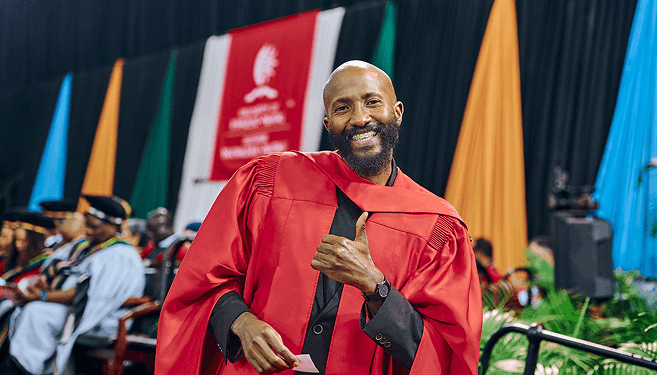
A desire to promote economic inclusion and create opportunities for persons with disabilities has culminated in a groundbreaking occupational therapy framework developed by UKZN lecturer, Dr Luther Lebogang Monareng.
Monareng graduated with a PhD in Occupational Therapy from UKZN for his study, ‘The Development of an Occupational Therapy Evidence-Based Framework for Identifying, Encouraging, and Supporting Self-employment for Persons with Disability in South Africa’.
He was supervised by Professor Deshini Naidoo, Head of the Discipline of Occupational Therapy at UKZN, and co-supervised by Professor Mogammad Shaheed Soeker, Deputy Dean of Health Sciences at the University of the Western Cape.
The research resulted in the Occupational Therapy Evidence-Based Framework on Self-Employment for Persons with Disabilities (OTeSP Framework), which provides a systematic approach to identifying, encouraging and supporting self-employment among persons with disabilities.
Monareng found no contextually relevant, occupational therapy-specific, evidence-based framework to guide self-employment support for persons with disabilities in South Africa, with similar limitations evident in the broader African literature reviewed. Existing frameworks were largely developed in high-income countries and did not adequately reflect the realities of low- and middle-income contexts.
“The OTeSP Framework addresses this gap by integrating South African evidence, the perspectives of local key role players, disability inclusion principles, occupational therapy practice, policy considerations, empowerment theory, systems theory and entrepreneurship,” said Monareng.
The framework is intended to benefit persons with disabilities, occupational therapists, vocational rehabilitation practitioners, government departments, disability organisations, communities and the broader economy. Ultimately, it aims to promote economic inclusion, reduce barriers to participation, enhance self-determination and improve quality of life.
His research interest was shaped by his upbringing and personal experience of seeing how self-employment opportunities helped support his family. As an occupational therapist, he became aware that livelihood pathways were often overlooked in practice and that much of the profession’s knowledge was based on concepts developed outside Africa.
“I wanted to pursue research that develops contextually relevant, African-centred approaches to participation, work and economic inclusion,” he said.
Born and raised in rural Tsakane Trust, Marite C, Bushbuckridge, Mpumalanga, Monareng’s childhood included building toy cars from wire and clay, fetching water from the river, attending initiation school as part of his cultural upbringing, and walking more than five kilometres to and from school. These experiences deepened his pride in his African heritage and helped shape his creativity, resilience and resourcefulness.
His experiences of rural life, including navigating limited resources, shaped his appreciation for education and his commitment to finding practical solutions to social challenges. His doctoral journey was equally demanding. In addition to managing the demands of a complex doctoral project, Monareng navigated manuscript and funding rejections, participant cancellations, technological challenges and power outages.
“Motivation alone is not enough. Discipline became my greatest asset,” he said, recalling early mornings when he began writing at 3am before starting his normal working day at UKZN.
Monareng credited his daughter, Bohlale, and his family for their support, as well as his supervisors, Naidoo and Soeker, for their mentorship.
He described his UKZN experience as enriching, challenging and transformative, with opportunities to present his research at conferences in Namibia, Kenya, Tanzania, Thailand and the United States.
Monareng has published seven manuscripts arising from his PhD, including four in high-ranking Q1 journals. His research was supported by the National Research Foundation, University Capacity Development Programme and UKZN Step-Up Programme.
“A PhD is less a destination than the beginning of a new chapter,” said Monareng, who is now validating and implementing the OTeSP Framework through his postdoctoral research. His long-term goal is to advance African-centred occupational therapy knowledge and strengthen research-practice partnerships that improve economic participation and inclusion for persons with disabilities.
Words: MaryAnn Francis
Photograph: Sethu Dlamini