

The University of KwaZulu-Natal (UKZN) has called for people-centred climate action that recognises climate change’s unequal effects and prioritises vulnerable communities in adaptation, resilience-building and policymaking.
Professor Anil Chuturgoon, UKZN’s Acting Deputy Vice-Chancellor for Research and Innovation, made the call during the ‘Sweden on the Road: Gender-responsive Climate Action’ dialogue at the University’s Westville campus recently.
Convened by the Embassy of Sweden, the event brought together policymakers, parliamentarians, researchers, students, development partners, and members of the diplomatic community to explore the links between climate change, gender equality and sexual and reproductive health and rights (SRHR).
Discussions aimed to generate practical recommendations for South Africa’s preparations for the 31st United Nations Climate Change Conference (COP31).
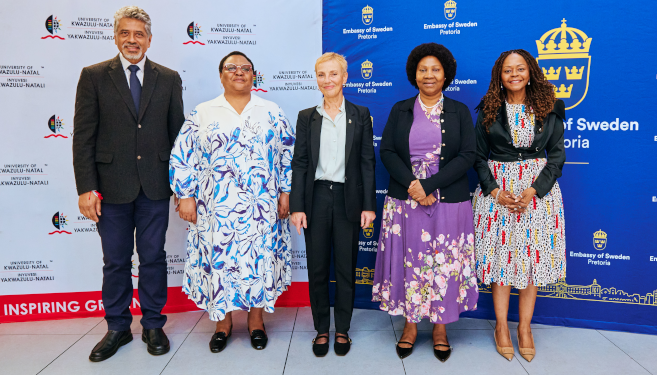
Attendees included Ms Anna Karin Eneström, Sweden’s Ambassador to South Africa; Ms Thoko Didiza, Speaker of South Africa’s National Assembly; and Ms Boemo Sekgoma, Secretary-General of the Southern African Development Community (SADC) Parliamentary Forum.
Chuturgoon called for climate policies that address communities’ differing vulnerabilities. “Let us keep people at the centre of the policies and plans we propose. While climate change is a global challenge, its impacts are experienced differently. We therefore want to be part of the important conversations about how we can adapt to climate change, build resilience and protect those who are most vulnerable,” he said.
In her keynote address, Didiza encouraged young people to take an active role in climate action, gender equality and SRHR. Reflecting on South Africa’s history of struggle, she emphasised collective action for social justice and urged students to approach contemporary challenges with initiative and resilience. She highlighted the country’s constitutional framework for SRHR, warning that budget constraints, gender inequality and climate shocks threaten progress.
She called for gender-sensitive, climate-conscious laws, disaster responses, and funding to protect vulnerable women and girls. She also stressed the importance of involving men and boys in SRHR discussions.
Eneström encouraged young people to engage with climate and SRHR issues. She said the Swedish Embassy’s SRHR programme in Pretoria had highlighted how floods, droughts and other extreme weather events affect women’s and girls’ health and rights.
“Climate challenges like flooding and drought directly impact the health and rights of women and girls in numerous ways,” she said.
She cited disrupted healthcare services and the unequal effects of disasters as reasons to prioritise gender equality and human rights in climate action.
Eneström highlighted universities’ roles in strengthening knowledge exchange between Sweden and South Africa. She referred to the South Africa-Sweden University Forum, which supports collaboration between universities in both countries.
She also encouraged UKZN students to explore Swedish Institute scholarships for further study and academic engagement in Sweden.
The panel discussion, ‘Beyond the Floods: Protecting Rights, Health and Dignity in a Changing Climate’, brought together Professor Kaymarlin Govender, research director at UKZN’s Health Economics and HIV and AIDS Research Division (HEARD); Dr Tamryn Crankshaw, a programme leader at HEARD; and Ms Amanda Gcanga, a senior urban policy analyst at the World Resources Institute.
The experts examined how climate-related disasters can disrupt essential services and deepen existing inequalities, particularly for women, children, young people, and marginalised communities.
Govender described climate change as a multiplier of risks associated with poverty, gender inequality, weak health systems, stigma, and discrimination. He highlighted disruptions to maternal and newborn healthcare and HIV and sexually transmitted infection services, alongside risks related to gender-based violence. He called for sexual and reproductive healthcare to form part of emergency response protocols alongside search and rescue and other essential medical services.
Crankshaw said climate disruptions can increase healthcare needs while weakening the systems intended to meet them. Damaged facilities, impassable roads, disrupted supply chains and the reassignment of healthcare workers can interrupt contraceptive services, antenatal care, maternity services, and other time-sensitive interventions.
She emphasised co-ordinated responses across sectors to gender-based violence. Survivors may need healthcare, police protection, justice services, psychosocial counselling, and shelter.
Gcanga linked the health and rights to the infrastructure and services communities depend on. She said flooding can damage homes, roads, electricity infrastructure and water and sanitation networks, affecting household safety, education and access to healthcare. She called for infrastructure planning that incorporates gender equity, social inclusion and meaningful community participation. Women, young people, older residents and traditional healers, she said, should be recognised as partners in developing climate solutions.
The panel also discussed sustained funding for inclusive climate resilience, stronger social protection and adaptation measures that safeguard health facilities and vulnerable communities.
Sekgoma thanked UKZN for hosting the programme and highlighted universities’ roles in generating evidence, advancing innovation, and equipping young people to shape the future.
“Universities are not peripheral to the climate agenda. They are among its intellectual engine rooms,” she said.
She called for stronger partnerships between parliaments and universities to ensure climate policies draw on evidence and respond to local communities’ needs. She urged students and young people to remain involved beyond the event by asking questions, demanding accountability, participating in decision-making and contributing to climate policy.
“Do not underestimate the power of your voice,” she said.
Words: Nombuso Dlamini
Photograph: Sethu Dlamini