

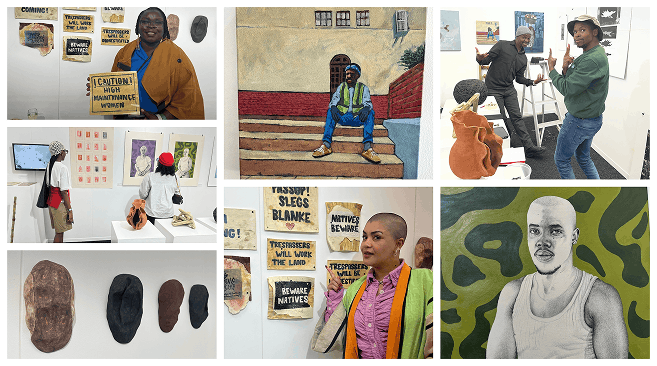
The University of KwaZulu-Natal (UKZN) Fine Art Department participated in the inaugural KZN Arts Fair at Hilton College recently, giving students an opportunity to engage with professional artists, galleries, collectors and auction houses.
The School of Arts supported the Department’s participation, enabling students to exhibit their work and gain insight into the professional art industry.
Master’s student Ms S’phelele Zungu described the fair as a meeting place for artists, galleries, collectors and auction houses.
Master of Fine Art student Ms Mandisa Ntshangase said the experience offered insight into how artworks are curated, presented and sold. “I really enjoyed attending the KZN Art Fair. It was interesting to see so many different kinds of artworks, meet some of the artists, and see how the work was curated and presented,” she said.
The presence of buyers and collectors also encouraged students to consider their work in the context of the art market.
“There were also buyers, which made me think more about art not only as something to look at, but also as something that can be sold and collected,” added Ntshangase.
Honours student and photographer Ms Sithembile Ngcobo, whose work explores memory, family and the preservation of ordinary Black life, sold both artworks she exhibited.
Ngcobo’s photographic practice is inspired by photographs found in Black family homes, particularly images preserved in family albums and living rooms. Her work considers how these private photographs differ from images preserved in institutional archives, while exploring memory, family, self-representation and the preservation of ordinary Black life.
“Through my work, I explore ideas of memory, family, self-representation and the preservation of ordinary Black life, paying attention to the dignity and significance held within these seemingly everyday images,” she said.
In addition to exhibiting her work, Ngcobo interned at the fair, giving her an opportunity to engage with artists from across South Africa and build relationships within the broader art community. “The experience pushed me to position myself more professionally, not only as a student but as an emerging artist who belongs in these spaces and can contribute to national artistic conversations,” she said.
The experience also resulted in Ngcobo selling both artworks she exhibited – something she had not initially anticipated. “I did not initially go to the fair with the intention of selling, but the interest in my work created an opportunity for my first sales,” she said.
The sales gave her a clearer understanding of the potential market for her work and demonstrated that her practice could resonate with audiences beyond the University. Ngcobo also highlighted the importance of engaging with established artists at the fair. Their interest in her work and willingness to ask questions about her practice made her realise that her work could enter conversations beyond the university environment.
Studio technician and master’s student Mr Khulekani Cele gained insight into the work involved in preparing a professional exhibition.
“It was exciting to visit the KZN Art Fair, especially because it was the first time it happened. It was also nice having my work there as one of the representatives of the Fine Art programme,” Cele said. He also gained insight into the process behind the exhibition. Being involved in installing the exhibition, he saw the fair being constructed before visitors arrived.
“I got to see the booths being constructed and meet some of the artists while we were working on the installation, before seeing them as the ‘superstars’ during the Art Fair,” he said.
The behind-the-scenes experience provided an understanding of the labour involved in presenting an exhibition and revealed another side of the professional art environment.
Zungu said the fair encouraged students to approach conversations with established artists professionally and consider different interpretations of artistic work. “I had to compose and conduct myself professionally at all times. It wasn’t about me individually, it was about other artists as well,” Zungu said.
The environment encouraged students to learn from one another and to consider artworks from different perspectives.
“Handling myself professionally allowed me to pause and reframe in every conversation, observe and engage without initiating any debate,” he said. “That gave me a chance to engage with my work and other artists’ works from their angle, not mine.”
This exchange of perspectives became one of the valuable aspects of the experience. Zungu described the artists at the fair as “pieces of the same cloth” whose different experiences were expressed through different artistic languages.
“Our work was different while our observation, analysis, and understanding was in sync,” he said. “Basically, speaking about different topics while our language is the same.”
Ngcobo said exhibiting outside the University challenged students to consider the commercial value of their work, including pricing, materials and labour.
“It almost bursts the bubble of being in a safe, familiar environment and challenges you to think about your work in relation to a much wider public,” she said.
The transition from academic practice to professional practice also presented practical challenges. Ngcobo noted that students often produce work primarily for academic assessment, without necessarily considering how it will be priced, marketed or sold.
“One of the challenges I faced was that, as students, we often make work primarily for academic purposes: it is assessed and then eventually goes back into a locker, studio or home,” she said. The experience forced her to think differently about the material and economic value of her practice, including the cost of materials, time and labour.
“I had to seek advice from people at the fair whom I trusted and who were already doing similar work,” she said.
PhD student Mr David Gush described the fair as an important introduction to the professional art world.
“It certainly gives students a better understanding of the ‘art world’. It is a hard world requiring lots of effort and time!” Gush said.
He described opportunities such as the KZN Arts Fair as “very important” and “an essential and commendable move by the Fine Art Department”. “It is often a student’s first contact with the real art world,” he said.
For the students, the fair also connected closely with the ideas explored within their academic practices. Zungu, whose ongoing research considers identity, reflected on the experience of seeing artists reveal aspects of themselves through their work while simultaneously participating in that process.
“For me it connected on the grounds of identity, from what we reveal about ourselves to other people, how we even reveal those things, what we do and how we do those things, what we say and how we say it,” Zungu said.
The fair gave students an opportunity to exhibit their work beyond the University, develop professional relationships and gain practical experience in the art market.
From seeing the construction of exhibition spaces and engaging with established artists to making first sales and learning how artworks acquire professional and economic value, the experience demonstrated that artistic development extends beyond the studio.
Words: Sinoyolo Mahlasela
Photographs: Supplied