

The 2026 Local Government Election results will be an important indicator of whether efforts to increase women’s political participation have resulted in meaningful progress.
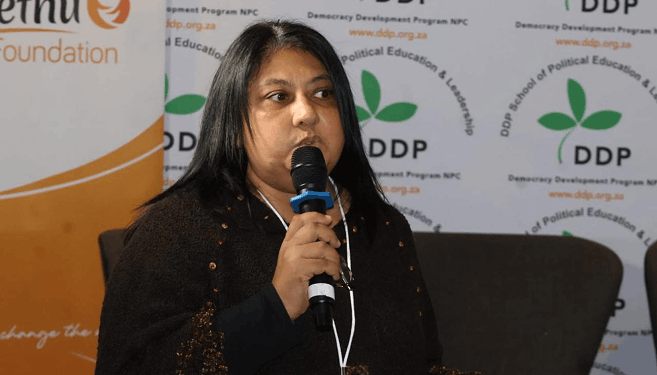
This is according to University of KwaZulu-Natal (UKZN) academic in the School of Social Sciences, Dr Lubna Nadvi, who was speaking at a Women in Leadership and Democracy Conference held under the theme: ‘Politics of Gender Representation – Enhancing Transformative Representation of Women in Local Government’.
The conference brought together participants from diverse backgrounds, including women councillors from the eThekwini Municipality, potential female candidates who will contest the 2026 Local Government Elections (LGE), educators, academics, women’s rights advocates from various civil society organisations, and community activists.
Nadvi has long been involved in gender empowerment initiatives and research exploring how women engage with political spaces at both local and international levels.
Her presentation focused on the politics of gender representation, with particular attention to statistics on women’s participation in local government in South Africa and the challenges they face.
According to Nadvi, there has been a decline in women’s participation in local government between the 2016 and 2021 elections.
“The 2026 LGE results will reveal whether there has been any improvement in efforts made to ensure greater participation by women in terms of both contesting as candidates as well as winning ward, council and mayoral positions,” said Nadvi.
She highlighted the continued marginalisation and exclusion of women within the broader spheres of government and public administration in South Africa and across the African continent.
“The evidence on the ground currently points to a further decline in participation by women over the last decade, and this is of serious concern, given the work done by gender advocates to ensure greater parity between men and women in the public and government sector,” she said.
“Given that females constitute more than 50% of the national population, it is essential that women’s voices are represented at all levels of governance, and especially in terms of policy that affects women and girl children,” she added.
The diversity of participants and presenters contributed to rich engagement and dialogue throughout the conference. Discussions extended beyond the challenges facing women in political spaces to explore practical ways of strengthening support for women candidates.
Participants discussed how women standing for election could empower and support one another, as well as how stronger support structures could be developed for women candidates seeking political office.
For Nadvi, the discussions also hold particular significance given her involvement in a network that provides support to survivors of gender-based violence (GBV).
Said Nadvi: “I am also part of a network that provides support to survivors of GBV, and hence the insights produced at this conference contribute valueble knowledge to current issues around women in political spaces, as well as highlighting the challenges that need to be addressed,” she said.
Nadvi shared that the conference provided an important platform for reflection, knowledge-sharing and collaboration, while highlighting the need for continued efforts to ensure that women are not only represented in political spaces, but are also empowered to participate meaningfully and influence decision-making at local government level.
Words: Sinoyolo Mahlasela
Photograph: Supplied