

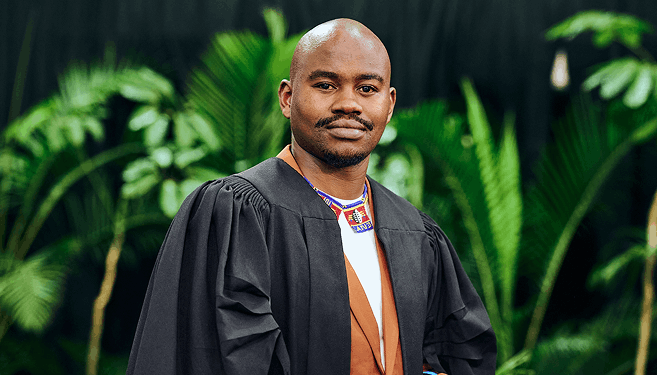
While studying at the University of KwaZulu-Natal (UKZN), master’s graduate Mr Siphamandla Ndlangamandla noticed that many young people remained ambitious and determined despite facing unemployment, financial hardship, social pressures and limited opportunities.
This observation prompted him to ask why some remain motivated and resilient in the face of such challenges and what inspires them to pursue their goals.
This question shaped his dissertation: ‘The Role of Inspiration in Influencing the Youth: A Case Study in University of KwaZulu-Natal (UKZN) Howard College’, which examined how inspiration influences students, aspirations, and life choices.
Under the supervision of Professor Oliver Mtapuri, Ndlangamandla set out to understand what keeps them moving forward when the odds are not always in their favour. He explored where their motivation comes from, who influences their choices and how inspiration can shape the way they see their futures.
“I became interested in understanding the sources of their inspiration and how inspirational figures influence their aspirations and life choices,” he said.
His findings showed that inspiration comes from multiple sources. Family members, particularly parents and relatives, emerged as important role models, while peers, mentors, lecturers and other influential figures within the university environment also played a significant role.
Ndlangamandla also discovered the growing influence of digital spaces. Social media and online peer networks were important sources of inspiration, with some participants identifying more strongly with relatable individuals online than with traditional celebrities.
The study revealed, however, that inspiration alone is not enough. Even highly motivated young people may struggle to act on their aspirations when faced with unemployment, financial constraints and limited support systems.
“For me, inspiration is much more than a positive feeling. It acts as a driving force that influences a young person’s values, ambitions and decision-making,” Ndlangamandla said.
His research suggests that universities can play an important role in helping students turn inspiration into action. His findings indicate that mentorship programmes, career workshops, alumni engagement and the celebration of student achievements can strengthen confidence and self-efficacy, while financial assistance, psychosocial services and other practical support can help address barriers to success.
Reflecting on UKZN’s tagline, ‘Inspiring Greatness’, Ndlangamandla believes greatness is nurtured through a combination of influences.
“When these different influences work together to provide encouragement, guidance, support, and opportunities, young people are more likely to translate inspiration into meaningful personal, academic, and professional achievements,” he said.
He hopes his research will contribute to practical strategies that empower young people to realise their potential, while encouraging educators and universities to create environments that support positive youth development.
Ndlangamandla expressed his gratitude to Mtapuri for his guidance and to the research participants for sharing their experiences. He also thanked his family and the Howard College campus community for their support.
He dedicates his work to every young person striving to discover their potential and create a better future despite the challenges they may face.
Words: Rakshika Sibran
Photograph: Sethu Dlamini