

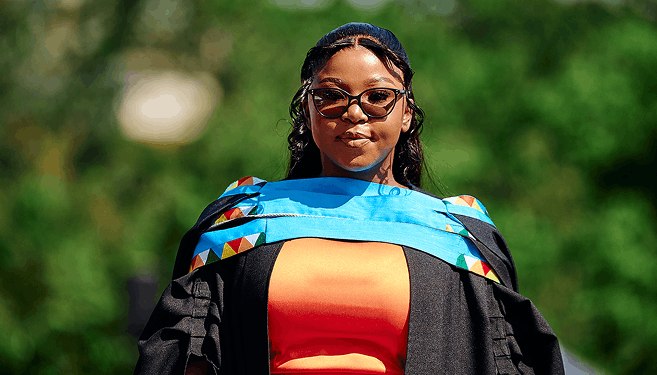
Ms Mayibongwe Ntombela graduated from the University of KwaZulu-Natal’s (UKZN) School of Social Sciences with a master’s degree following a study focusing on intimate partner violence, divorce and cultural conflict resolution.
Ntombela’s study explores intimate partner violence (IPV) and divorce among women in the Zulu community of the Phola area in Inanda. It examines cultural mechanisms for resolving marital conflict and women’s coping mechanisms, as well as the relationship between marital conflict, divorce and gender-based violence (GBV).
Although Ntombela faced challenges balancing the emotional and intellectual demands of her research, she believes “the study might even reach policymakers who might be able to influence and incorporate holistic methods to consider cultural methods in mediating marital conflicts and understanding intimate partner violence.”
The study’s findings suggest that divorce is culturally discouraged and that women who obtain a legal divorce face significant stigma and discrimination. The findings also identified cultural measures used to address intimate partner violence in the Phola area.
“These measures include family mediation, corrective behaviours, fines (Inhlawulo) and cleansing rituals to heal broken families (Inhlambuluko). Additionally, IPV constitutes one of the major leading factors in marriages, and experts have highlighted that spiritual problems such as ancestors, witchcraft and spiritual generational problems can manifest as IPV; with childhood and relationship trauma, communication being another root cause of IPV,” she added.
Ntombela’s study draws attention to the importance of culturally sensitive interventions for intimate partner violence and marital conflict that acknowledge cultural and traditional beliefs and consider kinship structures within local communities.
She thanked her family for believing in her, encouraging her and being fully present throughout this important chapter of her life. She expressed her pride in having a strong network of reliable and supportive people whom she can always turn to, whether things are going well or when she is facing challenges.
Looking ahead, Ntombela plans to develop her career by continuing to lecture, conduct and publish research, and contribute to academia and society.
She encouraged her peers to trust themselves and keep going even when facing difficulties or self-doubt.
Her parents, Mr Thamsanqa and Ms Duduzile Ntombela, wished her well, saying, “Sikufisela okuhle kodwa! Unwele olude!” translated from isiZulu as, “We wish you nothing but the best. May you live a long, prosperous life!”
“Mayibongwe ndodakazi, thina bazali bakho nalo lonke uzalo lwethu siyaziqhenya ngawe, ukuthi ube isibuko esihle kithi esizibuka kuso. Nangokuthi uziphathe kahle, wahlonipha ukukuthumela kwethu esikoleni, waze wafika esicongweni waphumelela.”
“Congratulations on your graduationIt has been amazing watching you grow as my younger sister, overcoming challenges and making it look easy. I am truly inspired by this. This is not the end, but just the beginning, the sky is not the limit and not even the universe is. Soar high!,” said her brother, Mr Mnqobi Ntombela.
Words: Sinoyolo Mahlasela
Photograph: Tisetso Nhlapo