

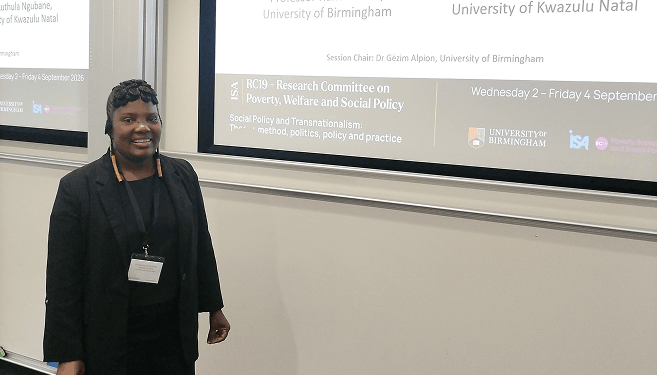
The University of KwaZulu-Natal’s (UKZN) Dr Nokuthula Ngubane has called for practical reforms to strengthen South Africa’s foster care programme, highlighting the need for improved administration, intersectoral collaboration and greater support for frontline practitioners.
Ngubane – a postdoctoral fellow in the School of Social Sciences under the supervision of Professor Desiree Manicom – presented her research at the International Sociological Association’s Research Committee 19 (ISA RC19) Annual Conference, hosted by the University of Birmingham in the United Kingdom.
The conference themed: ‘Social Policy and Transnationalism: Theory, Method, Politics, Policy and Practice’, brought together about 100 delegates from around the world to examine how international developments, partnerships and domestic policies shape social welfare systems.
Ngubane presented a paper titled: ‘Strengthening Foster Care Implementation in South Africa: Street-Level Perspectives on Policy and Practice Reform’. She also served as a discussant for a paper examining the colonial roots of Kenya’s National Hospital Insurance Fund, presented by Mr Daniel Künzler of the University of Fribourg and Mr Julian Götsch of the University of Bremen.
Her research explored how frontline practitioners understand the challenges facing South Africa’s foster care programme and the reforms required to improve its implementation. The programme has supported orphaned and vulnerable children through statutory interventions since the early 1960s. However, persistent administrative and institutional challenges have affected its ability to provide stable and sustainable care.
The scale of the challenge is reflected in reported figures showing a decline in foster care grant recipients from about 500 000 in 2010 to 190 675 in March 2026.
While existing research has documented the difficulties confronting the foster care system, Ngubane’s study focuses on practical solutions informed by those directly involved in delivering the programme, including social workers, South African Social Security Agency (SASSA) grant administrators and presiding officers in children’s courts.
Her findings identified administrative capacity constraints, inadequate collaboration between institutions and the need to reconsider aspects of the programme’s policy design. Four key priorities emerged: reviewing the relationship between statutory foster care placement and financial assistance; strengthening digital infrastructure for data verification, information management and case tracking; establishing structured mechanisms for intersectoral collaboration; and expanding staffing capacity while improving supervision, training and continuing professional development.
“Strengthening foster care implementation requires us to look beyond policy intentions and consider the realities of those responsible for putting policies into practice,” said Ngubane. “Frontline practitioners have valuable insights into the challenges they encounter daily, and their experiences should inform reforms that make the system more effective and responsive to the needs of children and their caregivers.”
Reflecting on her participation, Ngubane said the conference provided an important opportunity to engage with international scholars working on social policy and welfare systems.
Said Ngubane: “Engaging with researchers from different countries allowed me to learn about diverse approaches to social welfare challenges and consider how these experiences could inform comparative research on child welfare and foster care systems. The discussions also opened opportunities for future research collaborations and joint publications.”
The ISA RC19 Annual Conference attracts academics, policymakers, practitioners and representatives of non-governmental organisations working in social policy and related fields. Its interdisciplinary approach encourages critical engagement with the theoretical, methodological, political and practical dimensions of social welfare.
Ngubane’s participation highlights UKZN’s contribution to international scholarly discussions on social policy and the importance of research that connects policy development with the everyday experiences of practitioners and the communities they serve.
The next major gathering of the International Sociological Association, which will include RC19 sessions, is the XXI World Congress of Sociology, scheduled to take place in Gwangju, South Korea, from 4-10 July 2027.
Words: Sinoyolo Mahlasela
Photograph: Supplied