

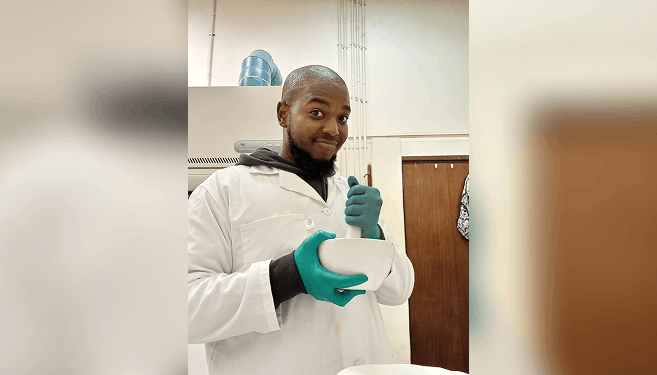
Mr Luthando Mkhize graduated cum laude with an outstanding 83% for his Master of Science in Engineering (Chemical Engineering) degree at the University of KwaZulu-Natal (UKZN).
This followed Mkhize’s research using an innovative approach to converting waste into renewable energy. Titled: ‘An Insight into Biogas Production by Anaerobic Co-digestion’, his thesis was supervised by Professor Amir H. Mohammadi.
“Having completed my undergraduate degree in chemical engineering at UKZN, I knew firsthand the quality of the engineering programme and the research facilities available,” said Mkhize. “I had built a strong foundation here, and the opportunity to continue my research under excellent mentorship made UKZN the perfect place to do my master’s.”
His research focused on biogas production from different types of local waste, including cow dung, fruit and vegetable scraps, and wheat straw. He investigated how mixing these waste streams in different ratios, together with treating wheat straw beforehand, could accelerate the breakdown process and increase biogas production.
Mkhize described his research as being about finding the most efficient way to transform South African waste into green fuel.
His interest in the field was driven by the dual challenges of waste management and energy scarcity in South Africa. Growing up in a rural area, he had observed resources such as cow dung being discarded or used as fertiliser, prompting him to consider its potential as sources of energy.
“We produce a lot of agricultural and municipal waste that often ends up in landfills, while simultaneously facing energy grid instability,” he said. “Finding a sustainable, engineering-based solution that can address both of these problems at the same time is what really drew me into this field.”
The significance of his research lies in its potential to provide a practical, mathematically validated blueprint for decentralised waste-to-energy systems using local waste streams. Rather than depending on expensive and energy-intensive treatment methods, Mkhize’s research demonstrates that mild, cost-effective treatments can achieve strong results.
He said this approach could make it financially viable for local municipalities or farms to generate their own clean electricity while producing high-quality biofertiliser.
Mohammadi commended Mkhize on his achievement and the relevance of his research: “Luthando achieved an outstanding final mark,” he said. “Biogas production research is an important and timely area that contributes to the advancement of sustainable energy and bioenergy technologies.”
Mkhize plans to work in Industry, where he hopes to apply his technical background to real-world engineering challenges in areas including process engineering, water resource management and renewable energy. He is also working with Mohammadi to prepare a manuscript based on his thesis for publication in an international journal.
“Professor Amir H Mohammadi has been an incredible mentor and provided invaluable guidance throughout this entire journey,” said Mkhize. “I also owe a massive thank you to my father and my family for their constant support as well as to my girlfriend and my friends, who have all been my pillars of strength.”
Away from his research, Mkhize enjoys cooking, watching movies, reading and exploring computer hardware and website coding. He has also served as a Supplemental Instruction (SI) Leader and tutor for undergraduate Engineering students.
“I am incredibly grateful for my time at UKZN, not just for the research, but for the opportunity to give back,” he said.
Words: Sally Frost
Photograph: Supplied