

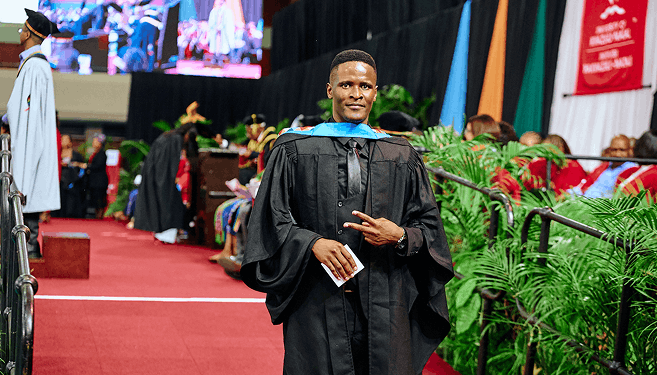
When Mr Thabiso Mpanza was doing well in science at school, the path ahead seemed obvious to those around him.
As a young man from Mtubatuba in KwaZulu-Natal, he was expected to pursue a science-related career. But Mpanza was increasingly curious about something else: people and how they think, why they behave differently and what shapes their choices.
That curiosity led him to Psychology and ultimately to a master’s degree in Industrial Psychology at the University of KwaZulu-Natal (UKZN), where his research examined an issue he had experienced personally – the influence of gender expectations on career choices.
His dissertation: ‘Understanding the Influences of Gender Socialisation on Undergraduate Students’ Career Choices in South Africa: A Scoping Review’, explores how families, schools, peers, communities, culture and the media can shape the careers young people believe are appropriate for them.
“My research began with my own life,” said Mpanza.
Raised by his single mother and surrounded by grandparents, aunts, uncles and extended family, Mpanza grew up in a close-knit community where he learnt discipline, resilience and the importance of understanding social expectations.
Those expectations became particularly apparent when he chose Psychology.
Although he had performed well in science, the assumption was that he should continue in that direction. Some people in his community did not understand his choice, while teachers questioned why he had not chosen science.
Rather than discouraging him, those experiences prompted a deeper question: how many young people choose careers because they genuinely want them and how many choose them because society has already decided what is appropriate for their gender?
His research found that such expectations can begin long before a learner submits a university application. Boys may be encouraged towards careers associated with strength, financial success or status, while careers involving care, emotions or helping others can be viewed as more suitable for women.
“What surprised me most was how persistent these gendered expectations remain,” Mpanza said.
Yet his own story also demonstrated that expectations do not have to determine a young person’s future.
When he explained his decision to pursue Psychology, his grandparents listened and supported him. Their response reinforced an important lesson: families can uphold their values while still allowing young people to forge different paths.
“Family influence does not always have to become family limitation,” he said.
His journey had also taught him the value of perseverance. Studying science at a rural high school with limited resources required hard work, dedication and making the most of what was available. He carried these values into university, approaching his Psychology studies with the same passion and commitment.
His choice also began to change how others viewed him. Once friends understood what he was studying, some began approaching him privately to share their experiences and emotions. For Mpanza, Psychology became more than a degree; it became a way of understanding and connecting with people.
His research has strengthened his belief that ability does not determine destiny and that universities can play an important role in helping students make career choices based on their interests, abilities, values, and aspirations rather than gendered assumptions. Diverse role models, meaningful career guidance and conversations about gender and culture can help students recognise the influences shaping their decisions.
Mpanza credited his supervisors, Miss Ntokozo Mntambo and Dr Ruwayda Petrus, for their guidance, patience and support, and expressed gratitude to his mother, grandparents, aunts, uncles and wider family for believing in him.
Mpanza hopes other young people, particularly those from communities where certain careers remain strongly associated with gender, will feel empowered to question those expectations and have the courage to create paths of their own.
“I was expected to follow one path, but I chose another,” said Mpanza. “I discovered something I loved, succeeded in it and found a sense of purpose.”
Words: Rakshika Sibran
Photograph: Sethu Dlamini