

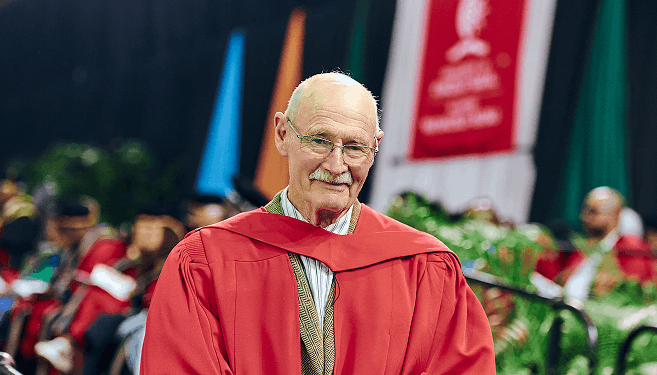
At an age when many people have long since retired from academia, Dr Kurt Sartorius has achieved a remarkable milestone, earning his second doctoral degree at the age of 78.
Sartorius graduated with a PhD in Medicine from the University of KwaZulu-Natal (UKZN) for his research into the regulatory role of microRNA (miRNA) in hepatitis B-associated hepatocellular carcinoma (HBV-HCC) and its potential for diagnosis and treatment.
His study: ‘The Regulatory Role of miRNA in Hepatitis B Associated Hepatocarcinoma (HBV-HCC) and Their Diagnostic and Therapeutic Potential’, explored how tiny molecules known as microRNAs influence the development and progression of one of the world’s most deadly cancers.
Chronic hepatitis B-associated liver cancer accounts for about 42% of global hepatocellular carcinoma cases, with a disproportionately high burden in sub-Saharan Africa, including South Africa. Despite advances in treatment, outcomes for patients with advanced disease remain poor.
Sartorius’ research examined how miRNAs regulate gene expression throughout the development of HBV-HCC and interact with the tumour microenvironment, immune system and epigenetic processes.
Using serum samples from 146 HBV-HCC cases drawn from two South African case-control studies, one based in Johannesburg and another conducted at Inkosi Albert Luthuli Central Hospital in Durban, the research identified 91 dysregulated miRNAs. Of these, 30 were upregulated and 61 were downregulated.
Bioinformatic analyses identified targeted genes involved in major cancer pathways, including PI3K/MAPK, TGF-ß/SMAD, JAK/STAT and TP53, as well as SAPK/JNK and RAS/RAF/ERK pathways.
One of the study’s key outcomes was the development of a three-miRNA serum-based diagnostic panel, which demonstrated 95.9% sensitivity and 91.0% specificity.
Sartorius said the research provided important insights into how non-coding RNA influences hepatocarcinogenesis and could contribute to the development of biomarkers and complementary therapies. While the study is not the first of its kind internationally, he believes it makes an important contribution by providing evidence from an African population.
The research was completed as a PhD by publication, with Sartorius describing the experience as enjoyable despite the challenges of securing funding and maintaining the stamina required to complete the work. “I wanted a new challenge,” he said, explaining his decision to enter the specialised field of cancer research.
His academic journey has been as unconventional as it has been impressive. Born and raised in Springs, Gauteng, Sartorius followed in his father’s footsteps into academia and medicine-related fields, but initially pursued a career in economics. He has spent about 30 years in academia, moving from economics into medical sciences and, more recently, cancer research.
Before entering cancer research approximately 15 years ago, he also embraced adventure, including running a rainforest project in Brazil.
His academic qualifications include degrees from the University of the Witwatersrand (Wits), the University of Pretoria and UKZN. Sartorius credited his UKZN supervisor, Professor Anil Chuturgoon, Deputy Vice-Chancellor for Research and Innovation, with encouraging him to pursue the doctorate.
“My supervisor told me that if I wanted to be taken seriously in this field, I had better get a PhD,” he said. He currently holds a post-retirement contract at Wits and an honorary position in UKZN’s School of Medicine.
Chuturgoon commented: “It has been a privilege to supervise Dr Kurt Sartorius through his PhD studies on the regulatory role of miRNA in Hepatitis B virus-associated hepatocellular carcinoma (HBV-HCC). Liver cancer linked to chronic Hepatitis B infection remains one of the most pressing cancer burdens in our region, and Kurt’s thesis made a genuine contribution to understanding how these small non-coding RNA molecules drive the disease from early infection through to chronic inflammation, fibrosis and, ultimately, malignant transformation.”
“What stood out throughout his candidature was his rigour in translating complex molecular findings into work with real diagnostic and therapeutic relevance – mapping dysregulated microRNA signatures that could one day underpin blood-based screening tools for a cancer that is too often diagnosed too late. His research has already been published in leading international journals. I congratulate Dr Sartorius on this achievement. It is graduates like him who help position UKZN’s research on the African disease burden on the international stage,” said Chuturgoon.
Sartorius continues to combine academia with adventure. In 2022, he paddled down the Amazon, and in 2023 and 2025 he undertook climbing expeditions in the Andes in Peru.
Reflecting on his latest academic achievement, Sartorius said: “Relieved, I am nearly 78 years old. This is my second PhD.”
Words: MaryAnn Francis
Photograph: Sethu Dlamini